


Botanica Obscura
Unearth the extraordinary roots of the world’s most specialized flora.
Glacial Buttercup
Welswitschia Mirabilis
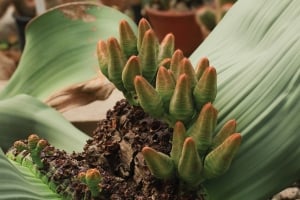
Deep within the landscape of Namibia’s coastal desert, the tangled leaves of the Welwitschia mirabilis plant present a sculptural silhouette against the surrounding sands. An unlikely choice of address? Not for welwitschia: it’s exactly where it was meant to be. Growing low and wide, each plant can live to be 2,000 years old, producing only two continuously growing leaves throughout its entire existence. These leaves, emanating from the plant’s crown, eventually split into ribbons, their withered tips contributing to its despondent appearance, even as a colossal taproot reaches deep beneath the desert surface into hidden reservoirs of water.
Although how welwitschia originally came to call this environment home is a matter of scientific and philosophical discussion, its ark-like presence is indisputably vital to the survival of multiple species that depend upon it for refuge and sustenance. Growing, on average, to roughly three feet across its crown and five feet in height, with leaves reaching lengths of up to 13 feet, it is an essential shelter to the Cape hares and geckos that find protection and shade beneath it; oryx antelopes, zebras and rhinos that feed upon it; insects that pollinate it; and the welwitschia bugs that consume the plant’s sap.
The welwitschia’s ability to not simply endure, but thrive in the region’s extreme conditions is a testament to the precision of adaptation. In a landscape defined by heat and aridity, every part of the plant reflects an extraordinary capacity to conserve resources and endure.
Strategic Adaptations
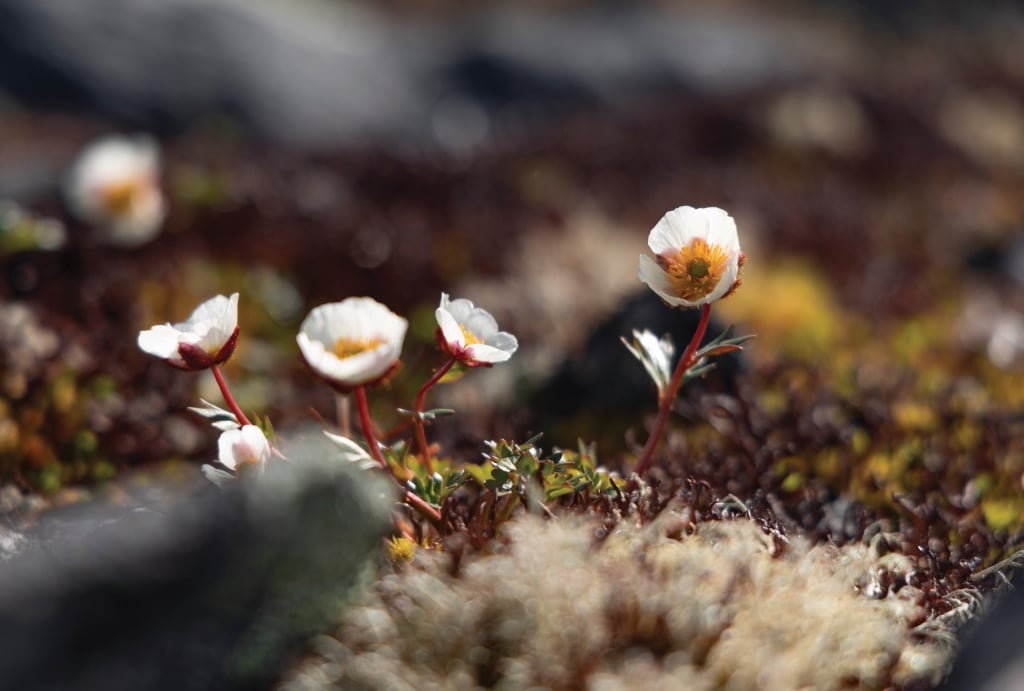
Nature has a remarkable way of finding opportunity wherever it takes root. Across the globe, plants have adapted to flourish in some of nature’s most distinctive landscapes. From frozen tundra to windswept deserts, myriad species possess specialized characteristics that allow them to adapt to and thrive within their surroundings. Plants including the Arctic willow, glacial buttercup and Arctic poppy have developed coping mechanisms to thrive amid freezing temperatures, extreme altitudes, powerful winds and long periods of ice. The Arctic willow, a creeping shrub, protects itself from freezing airstreams by growing in a prostrate, carpet-like pattern along the ground in tundra locales, while the glacial buttercup is capable of flowering among gravel even in icy conditions.
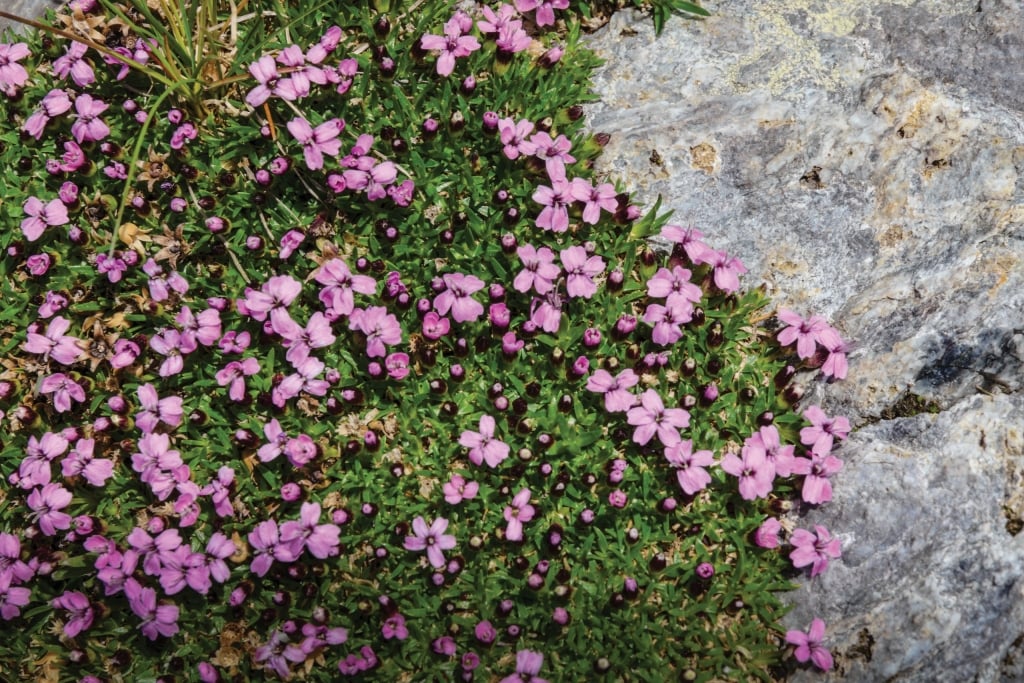
Moss Campion
“Alpine plants are some of the most specialized in the world,” offers Jennifer Ramp Neale, Ph.D., Director of Research and Conservation at Denver Botanic Gardens. “Adapted for cold, wind and high UV exposure, alpine plants often defy our understanding of the life of a flowering plant. From densely packed cushion plants such as moss campion to the slightly taller Avery Peak twinpod, alpine plants fast-track their annual growth cycle.”
It’s also true, explains Dr. Wesley Knapp, M.S., Ph.D and Chief Executive Officer of the Center for Plant Conservation, that the most extraordinary plants are not always the rarest or the strangest.
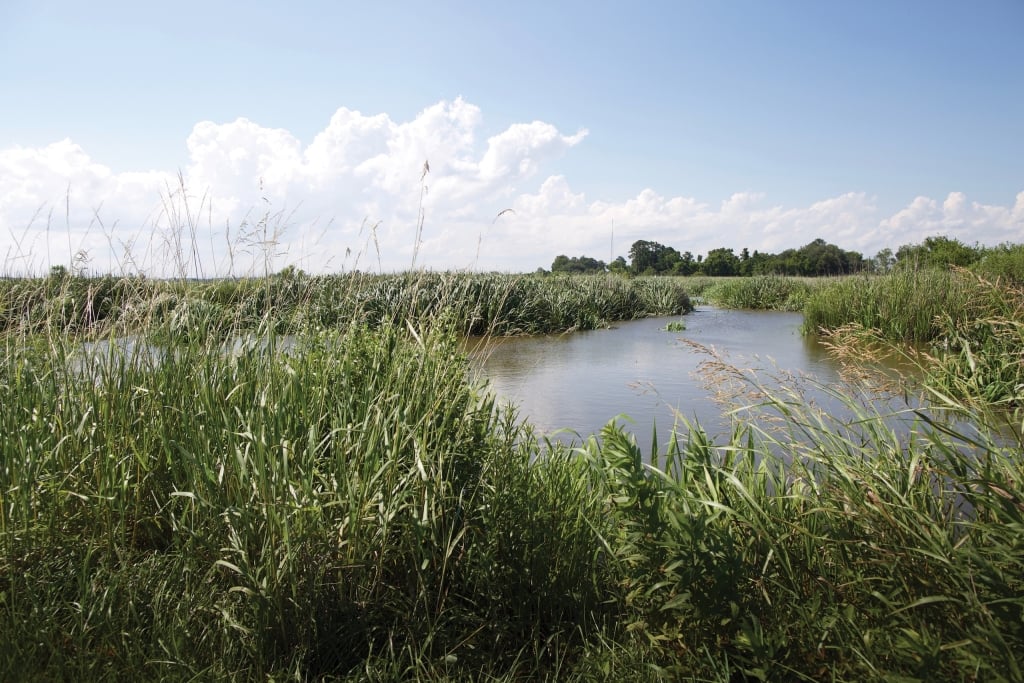
Salt Marsh
“Often, they are species that evolved to thrive in unique conditions — and, in doing so, they created ecosystems for everything else,” says Knapp. “A great example is growing right along the Georgia coast. The salt marshes around Sea Island exist because plants such as black needlerush evolved to thrive in salty, marsh conditions with large changes in tides and shifting sediments that other plants are not equipped to handle. Those dense marshes stabilize shorelines, store carbon, filter water and provide a nursery habitat for fish, shrimp, crabs, birds and countless other species. Black needlerush is one of the most important plants many coastal visitors may never notice, yet it covers vast expanses of salt marsh from the Atlantic Coast to Texas, often forming nearly continuous stands that stretch for thousands of acres.”
Architects of the Forest
Remarkable strategies for survival have evolved in highly specialized plants, and in some cases, for creating the environments around them. A remarkable example can be found across the southeastern United States in the longleaf pine ecosystem. They are uniquely adapted to a fire-shaped environment — tall and wide. In the first years of life, a young tree grows in a grass-like stage, with the growing point kept low to the ground and protected from flames. As they grow, they develop thick bark and other adaptations that enable them to survive fires that would destroy less specialized species.
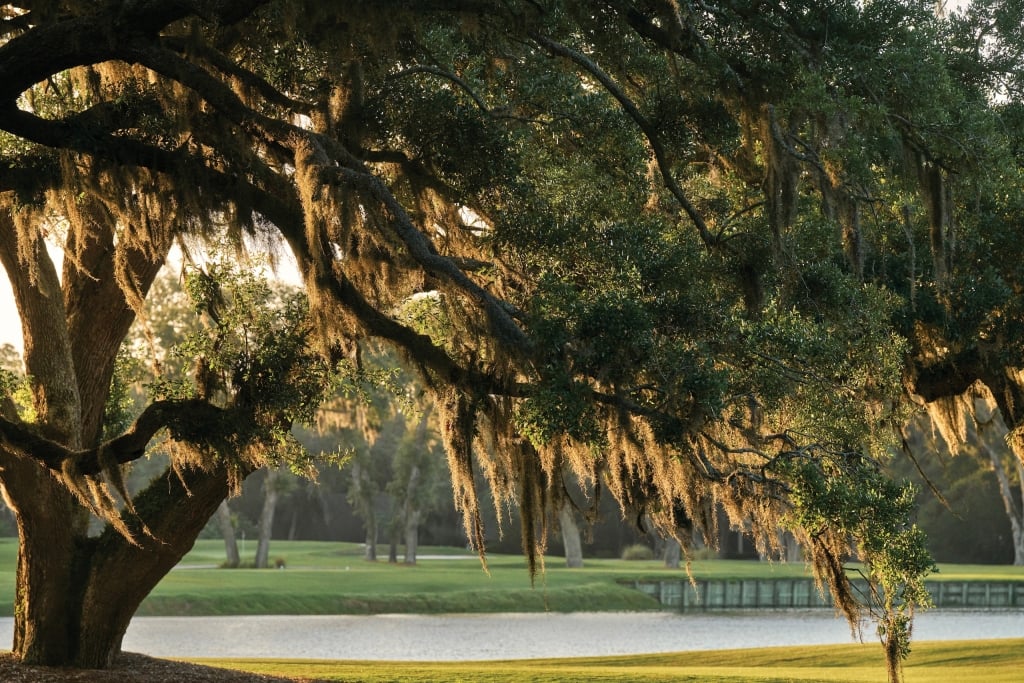
Live oak tree at The Lodge at Sea Island.
Immediate Dominion
The singular conditions of niche habitats like those found at Sea Island and nearby stretches of the South Georgia coast have given rise to a number of specialized species — each specifically suited to the region’s warm subtropical environment.
These species, according to Haley Watkins, Sea Island Lead Naturalist, include maritime forests of live oaks, the spartina cordgrass comprising massive salt marsh wetlands and clusters of sea oats that flourish throughout the coastal sand dunes. Each, Watkins explains, is regarded as a keystone species, thanks to its essential role in the surrounding environment and broader ecosystem.
“Each native plant helps to build unique habitats for a wide array of coastal wildlife,” says Watkins. “Southern live oak trees are one of the most extraordinary species that can be found on Sea Island and along the southeast coast. These trees — known for their towering branches draped in Spanish moss, resurrection fern and countless epiphytes that make their home in the tree canopy — are particularly well suited for our coastal area because of the extensive root system that anchors them to the soil and helps them withstand powerful winds.”
Live oaks also possess incredibly strong heartwood that allows them to thrive in coastal conditions. Watkins explains that even in the salty environment along the Sea Island shoreline, live oaks can withstand the salt spray that comes off the ocean.
“The phenomenon of ‘salt pruning’ often leads to trees growing in sharp, twisted angles as each branch veers away from the saltier air while the tree itself survives in some of the least expected locations along the water’s edge,” says Watkins. “In the right environment, these trees can even live to be over 600 years old.” On St. Simons Island, a 300-year-old live oak nicknamed “Old Ironsides,” with a circumference of nearly 30 feet, was named the St. Simons Land Trust’s 2026 Tree of the Year.
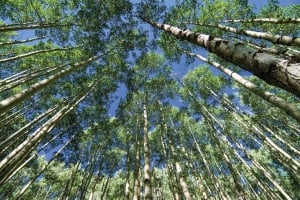
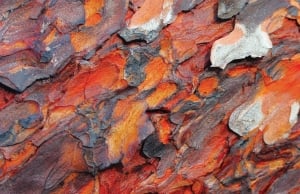
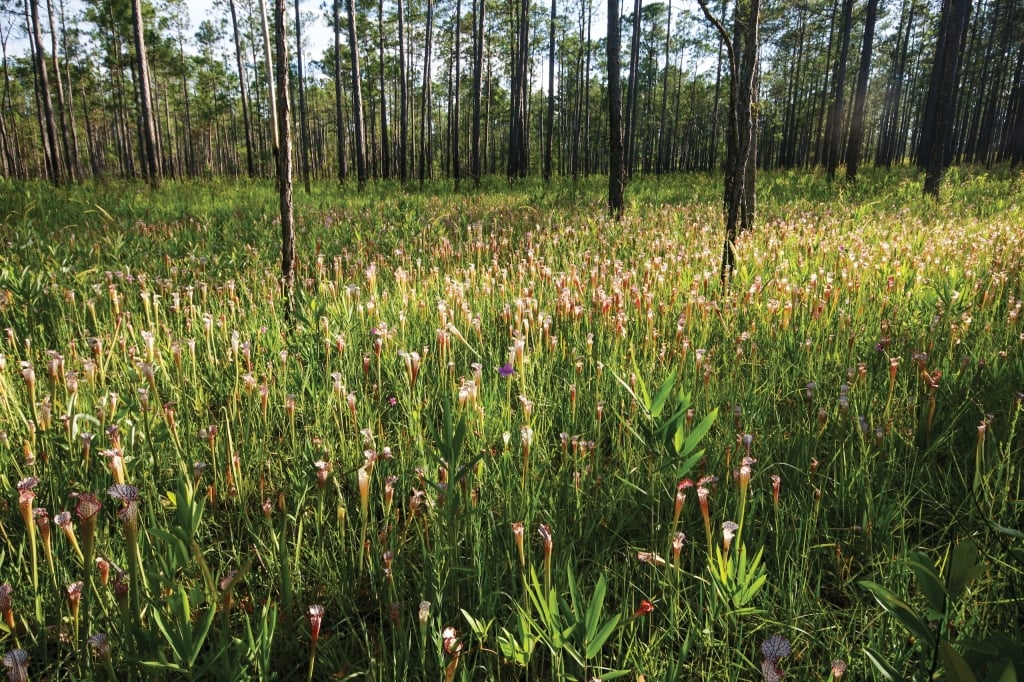
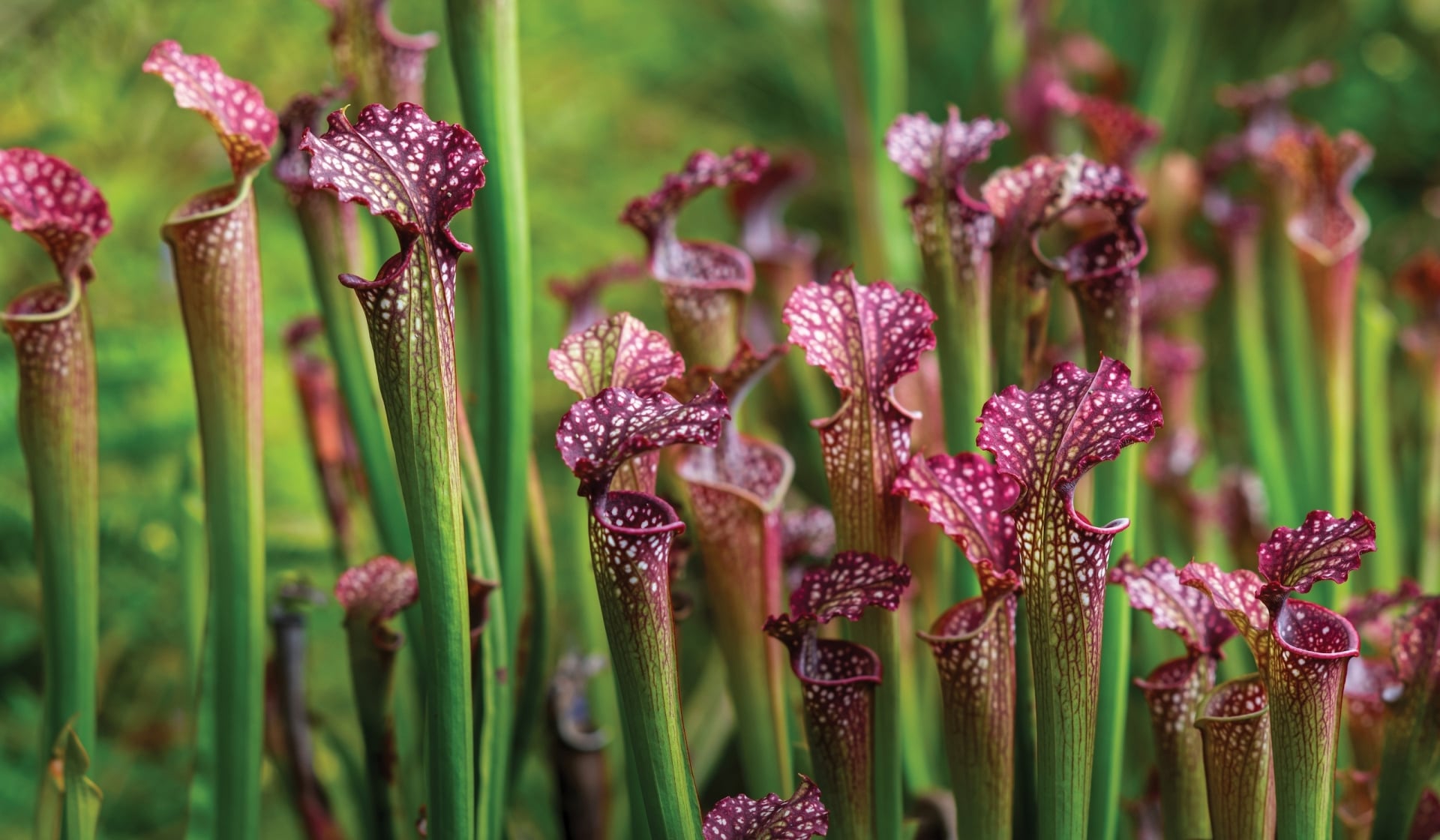
Pitcher Plants; Young longleaf pine (top left); Georgia longleaf forest (middle left); Longleaf bark singed by fire (bottom left).
Those fires are not simply destructive; they are essential to the habitat. Fire helps keep the open, sunny conditions that longleaf pine ecosystems require by burning dense shrub and preventing hardwoods from taking over the landscape. Under the trees, a remarkable collection of grasses, wildflowers and other specialized plants thrives, creating habitat for an equally distinctive range of wildlife.
Gopher tortoises dig burrows in the sandy soil, providing shelter to dozens of other species. The red-cockaded woodpecker relies on mature longleaf pines for nesting, and the carnivorous pitcher plants have evolved to capture insects in the soil of the ecosystem around the pines.
In this way, the longleaf pine is more than a tree adapted to a difficult environment. It underpins an entire community, whose very survival depends on the intricate relationship between plants, wildlife, soil and fire.
“Their story shows that evolution doesn’t just make organisms that fit into ecosystems,” Knapp says. “Sometimes it makes plants that build ecosystems. They are not just part of the scenery. It is the foundation on which entire communities can live.”
The longleaf pine landscape is a powerful reminder that adaptation is seldom an act of solitude. A plant adapts to its environment, and in doing so, can change the environment itself — creating a world in which countless other species can take root.
The Matter of Provenance
Some of Georgia’s most extraordinary plants thrive in places where survival seems unlikely. In the state’s acidic bogs and savannas, native carnivorous pitcher plants have developed a particularly unusual strategy for obtaining the nutrients they need. Rather than relying solely on the naturally lean soils beneath them, these specialized plants supplement their diet by capturing and digesting insects.
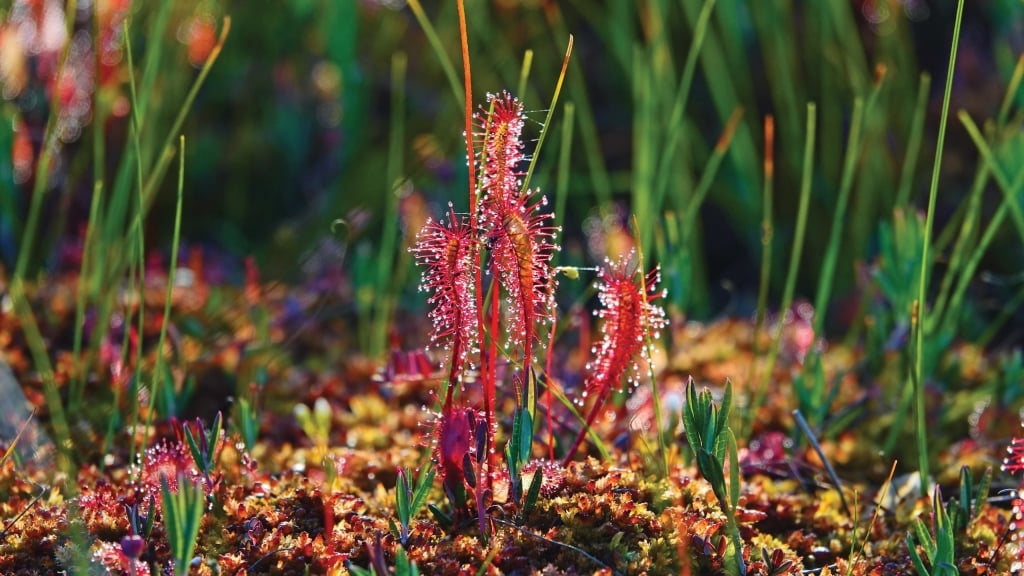
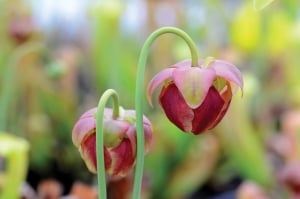
Pitcher Plant flowers; Sundews (top).
Georgia is home to several native species of pitcher plants, including the yellow pitcher plant and the hooded pitcher plant. Their tall, tubular leaves have evolved into intricate structures that help the plants gather nutrients in an ingenious way. Vibrant colors, enticing scents and slippery surfaces draw insects toward the pitchers, where the plant can absorb their nutrients. This clever adaptation allows pitcher plants to supplement what they gather from the soil and flourish in the distinctive environments they call home.
In the same wetlands and coastal environments, sundews use sticky leaves to capture tiny insects, while other specialized plants have evolved remarkable adaptations that allow them to flourish amid fluctuating water levels and intense heat. Each has found its own way to thrive.
What makes these plants particularly remarkable is not simply their unusual appearance or behavior, but their deep connection to place. Their survival is tied to the specific soils, moisture, fire patterns and ecological relationships of the habitats in which they evolved. That relationship between plants and place is central to what makes a species extraordinary.