


Connection Unabridged
How bridges bond the world across centuries and continents.
Kalogeriko Bridge in Greece; Etching of the Old North Bridge at Concord, Massachusetts (right).
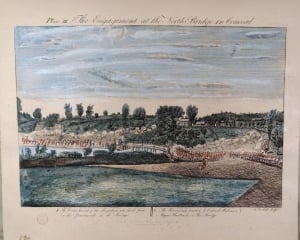
The sun rose in Concord, Massachusetts, on April 19, 1775, like any other. Warm light cut through quiet air on a crisp spring morning, but there was motion in the mist. Hundreds of colonial militiamen were moving toward the Concord River. Meanwhile, the British searched the town for weapons and supplies. Between them was North Bridge, a fairly unremarkable wooden crossing that would soon be the setting of a pivotal turn of events. By midday, “the shot heard round the world” would zip through the air over the bridge, marking the first American military resistance of the Revolution and heralding a long battle toward independence. On that morning in 1775, the Old North Bridge became something more than a tool; it became the scene of a decisive moment and forever a player in history changing direction.
Bridges are easily overlooked as simply infrastructure, a practical solution to moving goods and people. But they are often more than just a connection between two banks. They can be a rebellious challenge of environment and geography, a poetic embodiment of art and culture or a living history of human perseverance and belief. Their building blocks, be it lumber, steel, granite or stone — reveal ingenuity, innovation and grit. Their design reflects a society’s priorities: defense, beauty, strength, wit and power.
The First Stone
One of the earliest surviving bridges still crossable today is Greece’s Arkadiko Bridge. It is a simple corbel arch pass made of limestone blocks stacked inward until the sides meet. In the Bronze Age, it carried chariots. Today, more than 3,000 years later, pedestrians still cross it.
Bridge engineering would come a long way in 1,300 years, evolving from this simple stone crossing to a triple-decker triumph of imperial reach and artistic achievement. The Roman Pont du Gard, built in approximately 50 C.E., carried not horses but water. Its design completely reworked the constraints of geography. The aqueduct would flow life-giving water from a mountain spring toward what is now Nîmes, France, using a subtle gradient. Built, of course, without modern mechanical equipment, it reflected an astonishing understanding of surveying and masonry. It worked with, not against, the laws of nature to supply populations with water for fountains, baths and urban life. This infrastructure was both a public service and a working argument for the empire’s sophistication.
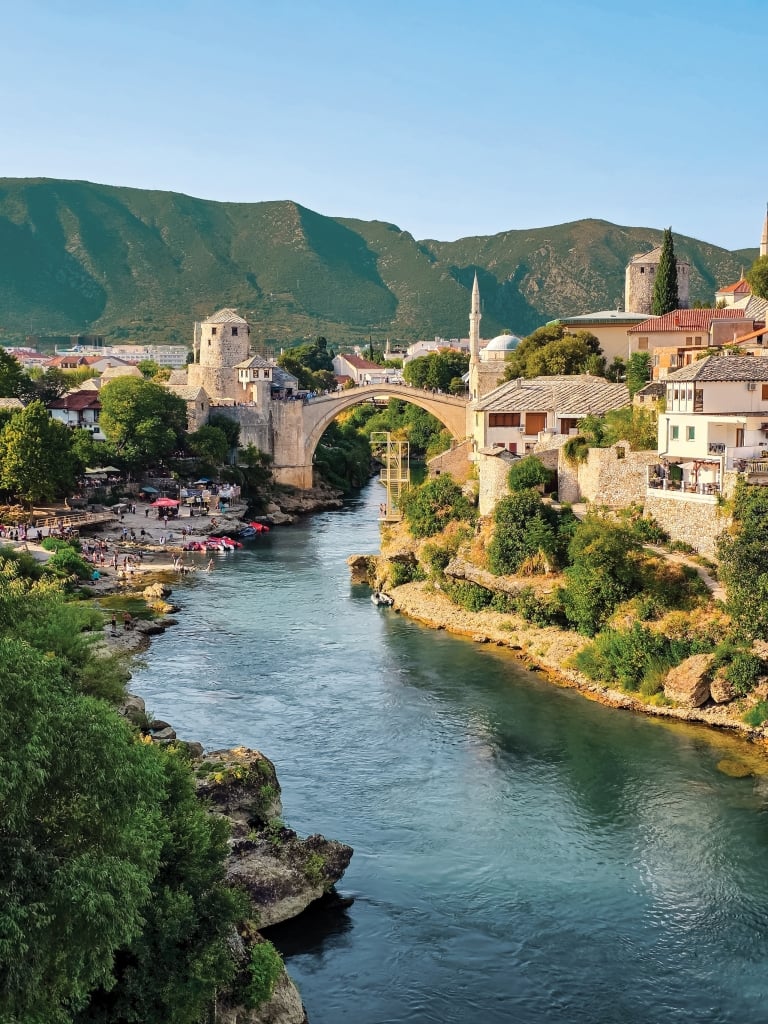
Stari Most in Mostar, Bosnia-Herzegovina.
As bridge building evolved, crossings became more than feats of engineering. Some bridges become so synonymous with a city that you can’t imagine one without the other. Prague’s Charles Bridge has been linking Old Town with Prague Castle since the 14th century and is now one of Europe’s most recognizable architectural landmarks. Built from Bohemian sandstone and lined with statues added over centuries, the bridge outgrew its original purpose as a crossing. It became a stage for merchants and monarchs, artists and travelers, bearing the changing identity of Prague across the river below.
Further south, in the historic city of Mostar, Bosnia-Herzegovina, the Old Bridge, Stari Most, held even more profound symbolism. Built in the 16th century under the Ottoman Empire, its elegant stone arch connected communities across the Neretva River. The loss of the bridge, destroyed in 1993 during the Bosnian War, became a symbol of the division and destruction that surrounded the city. Rebuilt and reopened in 2004 in traditional style and materials, Stari Most became once again a physical connection between the two sides of Mostar and a powerful reminder that bridges can symbolize far more than the distance they cross.
Bridges made of stone weren’t the answer to every crossing. Timber bridges could be lighter and utilize physics like trusswork — triangles that distribute weight across a length. Europe’s oldest standing truss bridge, the Kapellbrücke in Lucerne, Switzerland, is a Medieval covered bridge design originally built as a fortification from attack. What started as a defense mechanism transformed into a living work of art when 17th-century artist Hans Heinrich Wägmann painted Lucerne’s history on the bridge’s triangular trusses above bridge-goers’ heads. When the bridge tragically caught fire, the city rallied to repair it and recreate the lost paintings, unable to imagine Lucerne’s identity without it.
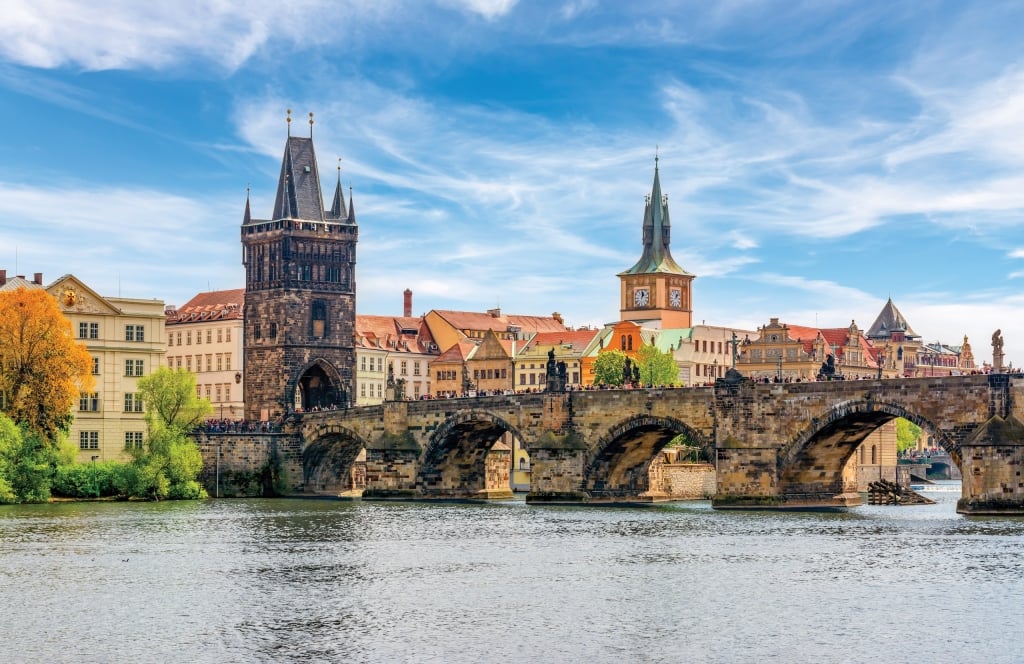
Charles bridge over Vltava river, Czech Republic.
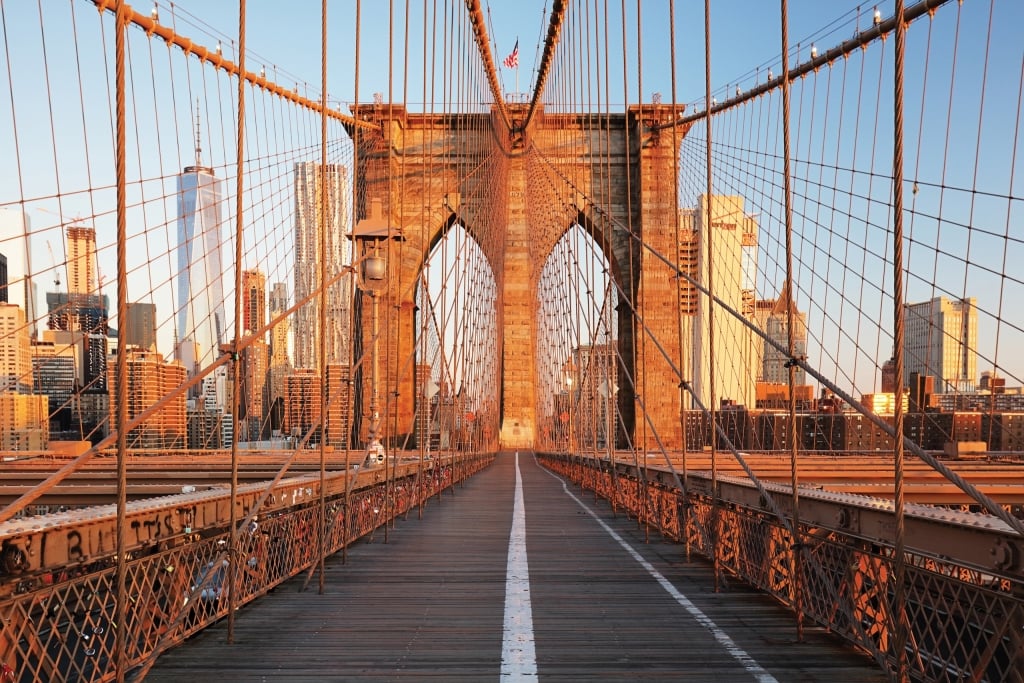
Crossing into Manhattan on the Brooklyn Bridge.
A Foundation for Steel Changes
The Industrial Revolution supplied bridge builders with transformative materials that could accommodate heavy loads and ambitious new distances — mass-produced iron and steel. For crossings like the one between Brooklyn and Manhattan, a wide and turbulent tidal strait, a suspension bridge longer than any previously built was required. But that wasn’t the only engineering feat to overcome. The East River’s soft silt bottom proved a poor foundation for granite pylons. To create a stable structure, they needed to reach bedrock deep beneath the riverbed. This required a relatively new technology of the time — caissons, which are pressurized wooden boxes that contained human workers excavating the river floor. The caissons required exceptionally strong, rot-resistant lumber. So they turned to one of the nation’s most prized timber sites. Some sources traced the wood down the coast to the Gascoigne Bluff mills on St. Simons Island.
Metals and alloys allowed the Roebling family of engineers to break span records with the Brooklyn Bridge, but it was the timber that made its Gothic-style arched towers possible.
“Our building materials are almost always sourced from elsewhere,” says Dominique Jean-Louis, Chief Historian at the Center for Brooklyn History at the Brooklyn Public Library. “The building materials, from wood to stone to marble, that literally hold up New York represent the best of the country and the best of the world.”
This combination of new technology with old-growth material couldn’t be a more fitting makeup for a bridge that would come to define a city known for rethinking convention and dreaming without limitations. Brooklyn Bridge debuted in 1883 as one of the tallest and proudest points in the New York skyline, but it wasn’t just a New York undertaking. With the help of timber sourced from hundreds of miles away, the bridge’s success wasn’t just a local achievement; it was a national triumph.
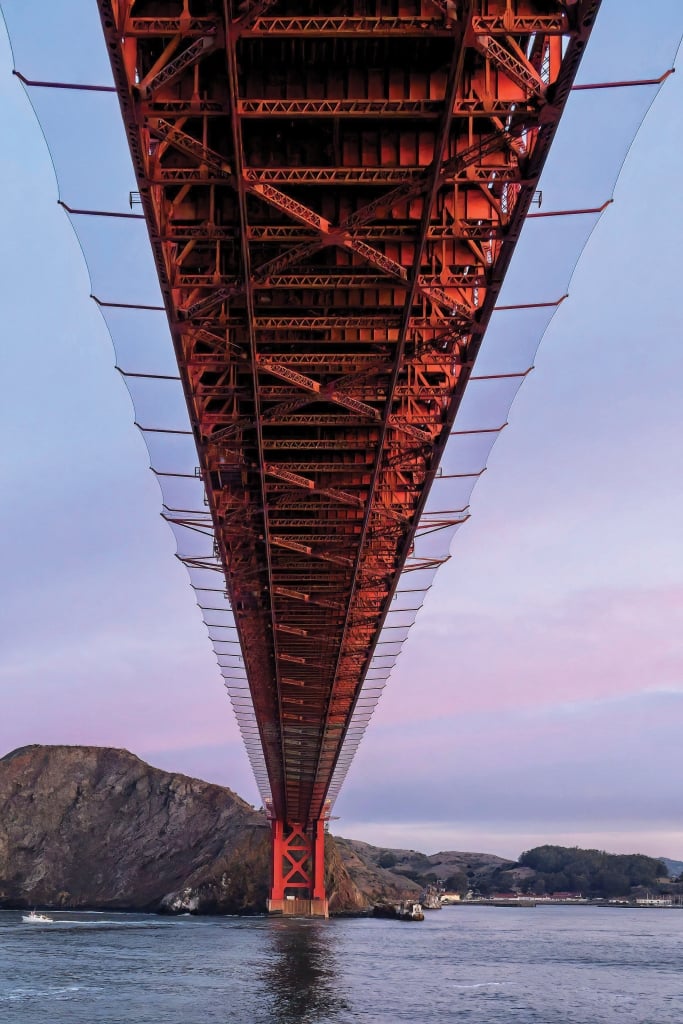
Beneath the Golden Gate Bridge.
A Bridge to Cross an Ocean
The Gilded Age brought railroad barons into the 20th century with big ideas and even bigger budgets. It was a time of rapid expansion, particularly railroad routes. In Florida, the Standard Oil Co-Founder and rail pioneer Henry Flagler set his sights on extending the Florida East Coast Railway from Miami to Key West, then a strategic port. But there was an ocean to cross first — miles of it. Sceptics claimed it was impossible, a railway spanning 128 miles through the Florida Keys across long stretches of open water, including a daunting 6.7-mile expanse, but Flagler forged on. His bridge used some of the most technologically advanced techniques of the time. At its time of completion in 1912, it was the longest bridge in the world and widely recognized as the “Eighth Wonder of the World.”
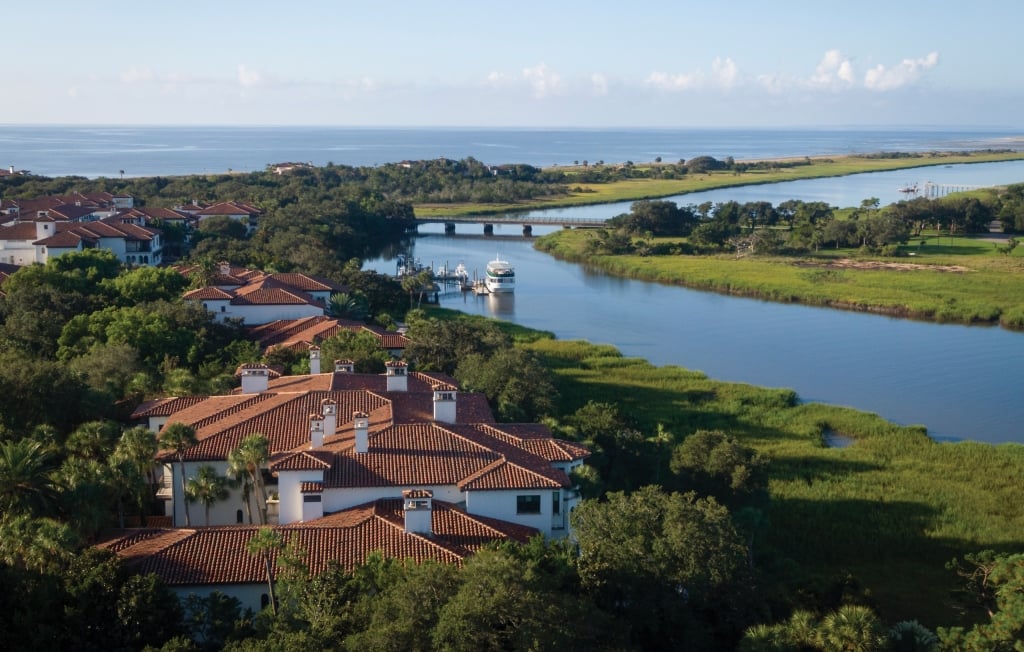
Like the Keys, the Georgia Golden Isles too were isolated and long thought impossible to ever reach by carriage or car. That is until 1924, when Brunswick native and Civil Engineer Fernando J. Torras completed a causeway between Brunswick and St. Simons Island that would transform the islands into resort destinations known the world over. “Sea Island Company Founder Howard E. Coffin understood the importance of this accessibility at a time when more and more Americans were traveling by car, and roads were being built to meet this demand,” says Sea Island Archivist Mimi Rogers. “It transformed access,” Rogers adds, “making St. Simons Island one of the very few coastal Georgia islands with a causeway to the mainland.” When The Cloister opened its doors just four years later in 1928, a short bridge across the Black Banks River connected St. Simons Island to Sea Island. The resort itself was now accessible by car, and the striking Gothic portico was an iconic welcome sight for new guests.
Eye on the Skyline
By the 1930s, bridges weren’t just a means of expanding the economy, tourism and progress, but important visual characters defining city skylines. The Golden Gate Bridge needed to solve the enormous geographic challenge of spanning the violent waters separating San Francisco and Marin County. But it also had its own unique environmental challenge — to be visible in the thick Pacific fog. Consulting Architect Irving Morrow gave it its now notorious color, “International Orange,” so it could remain visible while still complementing the Marin hills. Over 10 million square feet of steel was hand-painted in the clay hue, and is still manually touched up today. The unconventional color and Art Deco design have created a silhouette that anchors the San Francisco identity.
Black Banks River Bridge at Sea Island
The First Step
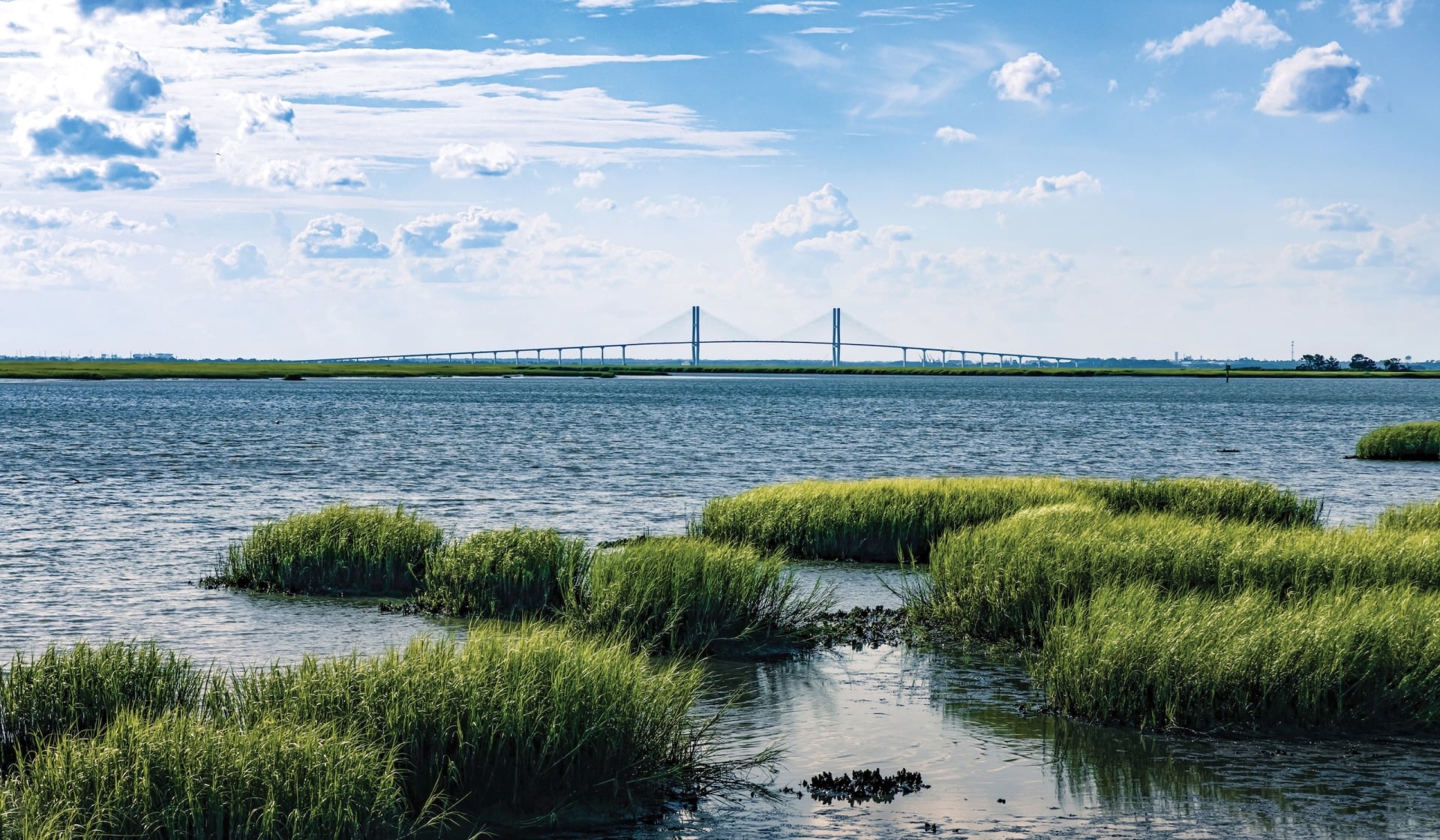
At some point, the mainland starts to fade, and Sea Island comes into view. It happens quietly, somewhere over the Black Banks River Bridge that connects the two, but for members and guests, crossing can feel like a change in the rhythm of the day. The familiar begins to give way to something slower, quieter and distinctly Sea Island.
Shoulders drop. Phones are stowed. The frantic pace of everyday life begins to fall away, replaced by the excitement of time on the island. For those who return often, the feeling can be almost instinctual. Once the bridge appears, the routines and responsibilities left behind on the mainland recede a little farther. Familiar places and favorite traditions await, along with the freedom to settle into the rhythm of island life.
“You can sense the shift when guests arrive to check in,” says Tara Kroll, Director of Rooms at The Cloister. “People are excited to be here, but there is also an ease that settles in. It’s as though crossing onto the island gives everyone permission to slow down and enjoy what brought them here in the first place.”
There’s something right about that feeling happening on a bridge. A bridge, at its most basic, connects one place to another. But beneath that, there are bridges that connect us to places, to people and even to other versions of ourselves. The Black Banks River Bridge does all three things. It brings members and guests to an island where generations of families have celebrated milestones, friends have reunited and new memories have quietly become traditions.
Bridges don’t have to be enormous to carry a powerful sense of arrival. For a modest-sized bridge, it’s a threshold between everyday life and escape, what was and what’s next. Maybe that is why bridges are so permanent. They remind us that making it to the other side isn’t simply about getting somewhere. It’s about what becomes possible when we do.
Reimagining the Crossing
Modern bridge design has progressed well beyond the basic question of how to get from one side to the other. Today, some of the most memorable crossings in the world are not just designed to solve engineering problems, but to create an experience. Architects and engineers are discovering new ways to turn infrastructure into art, defying expectations of what a bridge should look like and how it should interact with the landscape around it. In some cases, that means rethinking not only the shape of a bridge, but the very way it can share space with the environment around it.
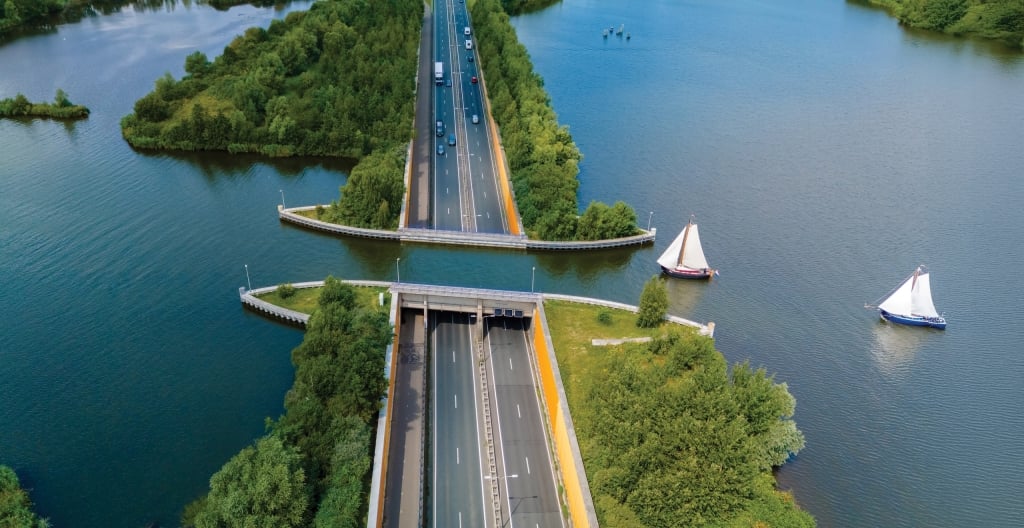
In the Netherlands, engineers took an inventive approach at the Veluwemeer Aqueduct, inverting the usual relationship between road and water. Rather than building a bridge over the lake or routing traffic around it, they designed a waterway to pass over the road. Cars pass under the canal, boats over it — a practical and visually unexpected solution. The aqueduct was built near Harderwijk and allows thousands of vehicles and watercraft to pass each other without getting in each other’s way. It’s an elegant example of how innovation doesn’t always mean building higher, longer or more dramatically. Sometimes the most amazing solutions come when we look at an old problem from a completely new perspective.
Stronger Than Nature
Bridge evolution may look like it has followed a straight line from stone to timber to steel, but innovation does not always appear in the likeness of the metal and the machine. Deep in the rainy, high mountain region of Meghalaya, India, the Umshiang Double-Decker Root Bridge required no steel, alloy or engineering team to build. Using the native rubber tree, the Khasi and Jaintia tribes weave together the roots of the tree over rivers that routinely flood. While most modern bridges deteriorate with age, this bridge grows stronger with time as the trained roots wrap around each other in an ever-firming clasp.
Bridges may feel like a mundane part of an everyday commute. Look closer and each crossing reveals something about the land and its people: the materials they knew, the environmental challenges confronted and the future they dared to imagine. Some bridges survive today as unused monuments, preserved by a people deeply tied to their memory. Others exist as impressive responses to geography and climate. These awe-inspiring reasons, perhaps, are why bridges show up in mythology. Folk stories plant challenging trolls beneath them and mysterious portals to other worlds beyond them. It’s not hard to imagine how these fables grew from real-life trials and triumphs, and why a bridge’s emotional weight — separation is temporary, any challenge can be overcome — stays with us.
Veluwemeer Aqueduct in Harderwijk, Netherlands