

It's About Time
Clocks as a testament to mankind’s fascination with measuring time.
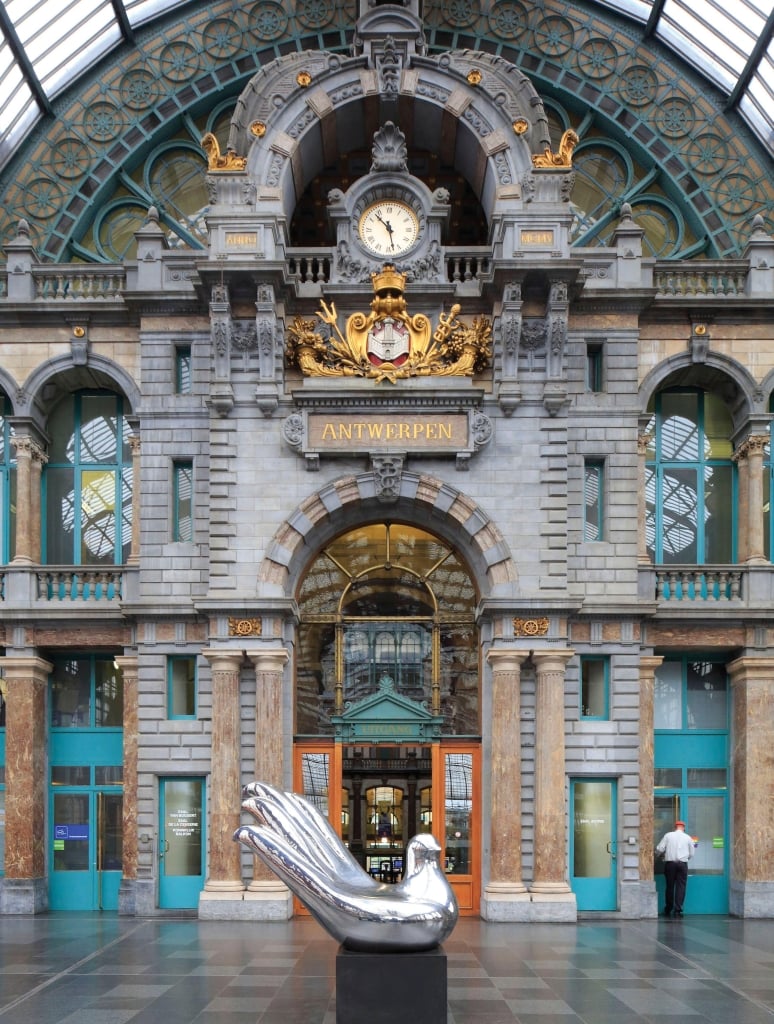
Clock at Antwerp-Central Railway Station
Since long ago, mankind has waged philosophical battles about the shape that time takes. Some maintain it’s simply a human construct that has little to do with the reality of the movement of the universe. Those who contend with train schedules and dinner reservations may beg to differ. While poets, songwriters and philosophers continue to grapple with an absolute understanding of what the true nature of time might be, most just don’t want to be late for work.
In communities worldwide, a central or significant public clock not only tracks our days but serves as an object with emotional associations. Sometimes, these are historical, as with the original Marshall Field Clock in Chicago. A city landmark located at the corner of State and Washington, it rose to fame when featured in a Saturday Evening Post cover by Norman Rockwell. In Rockwell’s painting “The Clock Mender,” a repairman can be seen setting the clock’s time with his pocket watch.
“Marshall Field was one of the first stores to install pane glass windows,” recalls Sharyne Moy Tu, who works at the Chicago Visitor Information Center at Macy’s, formerly Marshall Field & Company, on State. Long before texting was an option, members of the store’s management team noticed pieces of paper stuck in the corners of the windows. “When they opened the papers,” continues Moy Tu, “they were notes from folks telling their family and friends where to meet them. So, Marshall Field had the idea of building a clock at the corner of State & Washington. Then, folks could say ‘Meet me under the Clock,’ which became a famous saying.”
Early Adventures In Timekeeping
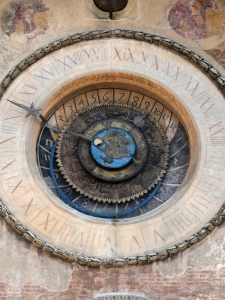
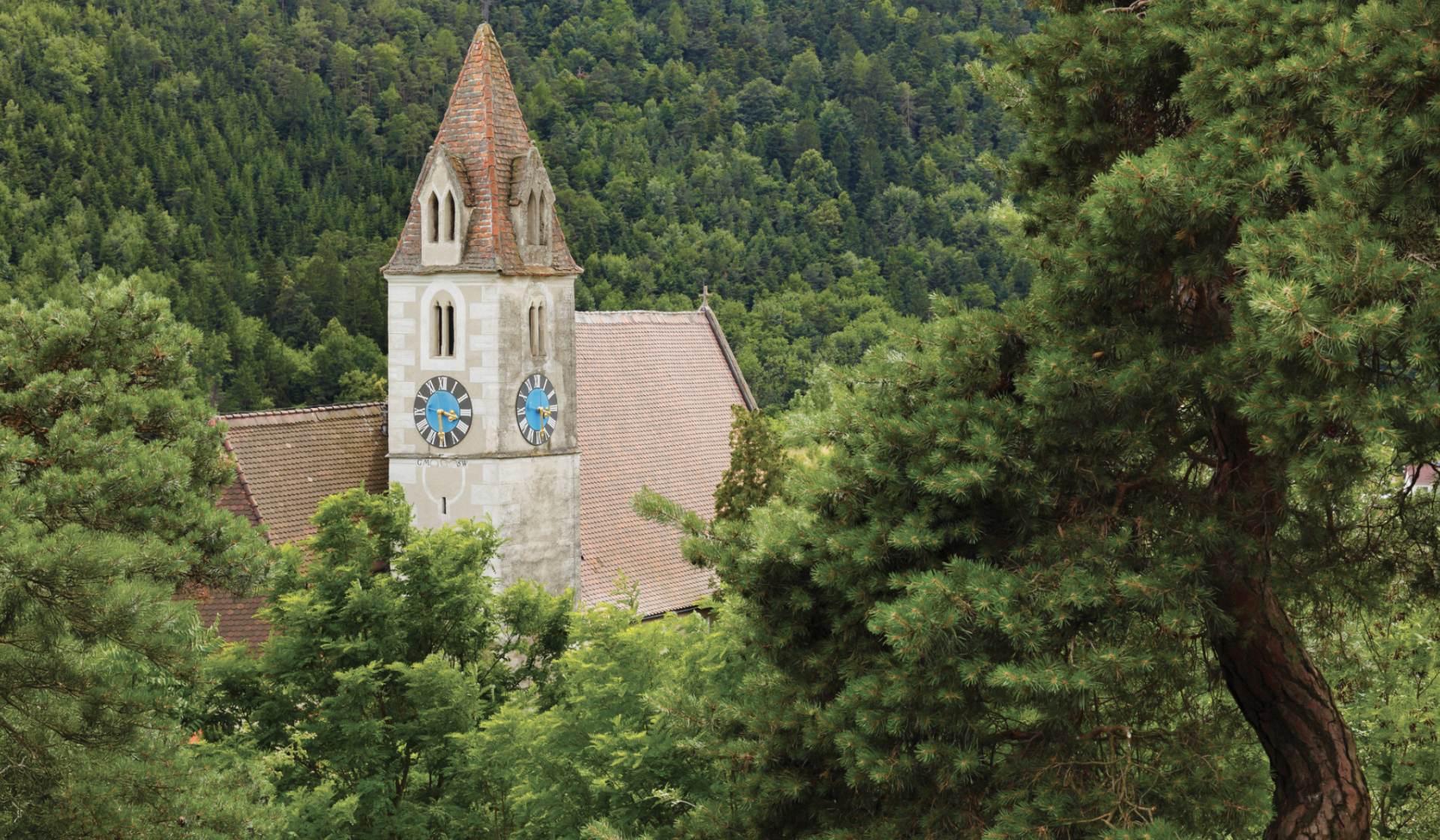
Palace of Reason Clock Tower in Italy
While the story of humankind’s very earliest achievements remains incomplete, records dating into antiquity suggest a natural progression in the desire to keep and record the passage of time. Early peoples developed a system that predated sundials, observing the movements of celestial bodies and planting stakes in the ground to track the length of shadows cast by the sun as it shifted higher and lower through the sky.
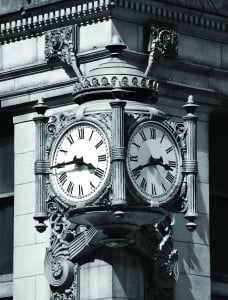
The Marshall Field Clock in Chicago
Sundials created by Egyptians, somewhere around 1500 B.C.E., have been found thatinclude uniformly divided grids around the base of an upright stake. At about the same time that these rudimentary contrivances were being utilized, water clocks were being developed in Egyptian, Babylonian, Chinese, Greek and other cultures. The earliest water clocks were a kind of cup or bowl that measured time by equating its passage to the flow of liquid either into or out of the interior of a vessel. Lines and markings carved into the interior provided a way for the observer to determine how much time had gone by as the vessel either filled or emptied.
Called “clepsydra” by the Greeks, water clocks grew in sophistication to include rudimentary gears and escapement mechanisms—a mechanical link that was independently controlled—to increase accuracy. As the complexity of water clocks increased, they became a viable form of timekeeping that found its way to Europe, where they were eventually superseded by the development of the hourglass, followed by later mechanical devices around 1300.
It wasn’t long, in the greater context of passing time, that the hourglass took up where water clocks left off. By 1338, a fresco depicting an hourglass was on display in Siena, Italy, at the Sala dei Nove within the historic Palazzo Pubblico palace. Created by artist Ambrogio Lorenzetti, it is the first example of an hourglass so far uncovered.
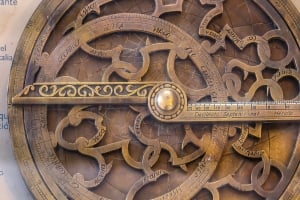
Brass Astrolabe
Sophisticated Calculation
Just as the White Rabbit in Lewis Carroll’s enduring tale “Alice’s Adventures in Wonderland” discovered, there is a reckoning to be had when late. By the late Middle Ages, large public clocks, often with astronomical components that detailed the position of planets, were displayed on buildings throughout many parts of the world, guiding city residents to their appointments and obligations. Housing intricate gears and dials, massive clockworks and fanciful mechanical facades such as the Orloj astronomical clock in Prague, the Glockenspiel in Munich and the Zytglogge in Bern became important points of civic pride and testaments to a community’s sense of place within the greater universe.
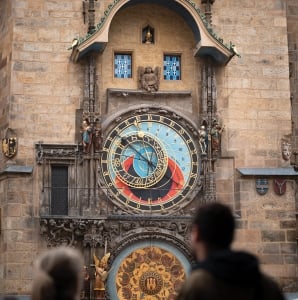
Prague Astronomical Clock
Simple or ornate, these clocks also helped populations large and small navigate their days. Clock keepers were regarded as important members of communities, oiling gears, adjusting hands, setting pendulums and maintaining the intricate workings for the benefit of the public.
Seminal figures in the development of clocks include 16th century scientist Galileo Galilei, who discovered the consistent oscillation of the pendulum, and Dutch scientist Christiaan Huygens, who went on to invent the pendulum clock. German clockmaker Peter Henlein parlayed his obsession with timepieces into the creation of the first portable spring- driven clocks, contributing to a legacy of timekeeping that often remembers him as the father of the modern clock and initiator of the world’s industry of horology—the art and science of measuring time. Henlein’s singular contribution of the pocket watch paved the way to the creation of the small, portable timepieces treasured not only by designers and collectors, but also prized by every person who dons a wristwatch today.
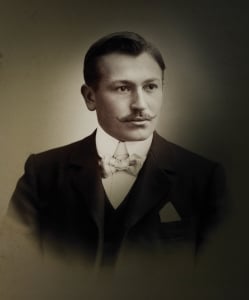 Hans Wilsdorf, founder of Rolex.
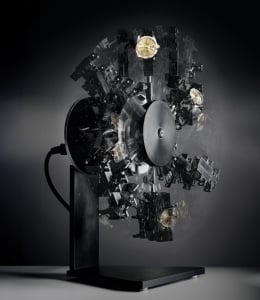 The Chronometric Performance of a Rolex watch.
Time, Refined
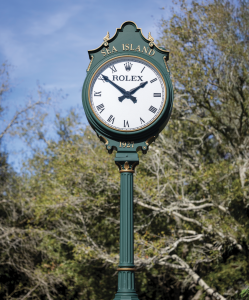
Rolex Clock at The Lodge at Sea Island.
Not so long ago, grandfather clocks and pocket watches were more than mere ways to remember when the evening meal was about to be served. Possessing such a device signified both wealth and a sense of refinement. These luxury items have since been replaced with other status symbols, including wristwatches from some of the world’s most renowned makers. Brands such as Rolex, Cartier, TAG Heuer, Jaeger-LeCoultre, Audemars Piguet and Patek Philippe carry a particular cachet of exclusivity that’s instantly distinguishable around the globe.
The prestige associated with Swiss watchmaker Rolex also extends to a collection of clocks that grace the grounds of select major championship golf courses, including those at Sea Island. Brannen Veal, Director of Sea Island Golf Club, explains that this elite collection of clocks is located at respected, well-established private clubs and resorts that share the Rolex company’s values.
“Since opening the Lodge in 2001,” said Veal, “and the unveiling of the Rolex clock at the same time, the two have become synonymous with the sense of luxury and excellence Sea Island is known for.” Centrally located near the practice putting green and practice area, it’s visible to all members and guests—an enduring symbol of craftsmanship, tradition and the timeless pace of life on this stretch of Georgia coast.
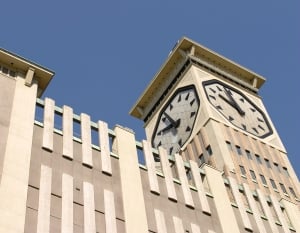
Allen-Bradley Clock Tower
Counting Down
The clock at Grand Central Terminal in New York City presides over the bustling comings and goings of millions each year, glanced at by those running for trains or arriving for meetings. Likewise, the 283-foot-tall Allen-Bradley Clock in Milwaukee, Wisconsin, serves as an important city symbol. Ranking as one of the world’s largest four-faced clocks, it was built by Allen-Bradley employees from the company’s Special Machinery Department.
“My understanding is that it’s really four separate clocks, each of them run by two motors—one powering the clock and the other changing the time,” explains Ben Barbera, Executive Director and President of the Milwaukee County Historical Society. “Given its height, it serves as a landmark throughout the city, and can be used as a navigational aid for boats on
Lake Michigan.”
In Denver, Colorado, the tower clock at Union Station counted out the minutes between the moment when starry-eyed arrivals stepped off the country’s first transcontinental train, and when their search began for fortunes in gold and silver. When the new, grand Beaux-Arts Union Station Depot opened in 1881, the 180-foot clocktower rose from the center. Destroyed by fire, reimagined and rebuilt in 1914, the station’s clock is one of Denver’s most iconic reminders of the city’s dynamic past.
“There’s been a lot of restoration of the clock,” notes Denver Union Station General Manager Ed Blair. Its importance to Denver’s residents is visceral. “We have to change it manually for daylight savings,” adds Blair. “Local residents and commuters will tell us as soon as it’s five minutes off. It is an important community and historical asset.”
Whether time is a loop, or linear, or perhaps takes a form beyond what our limited human imaginations can comprehend, it can be argued that every clock is a time machine. Certainly, our obsession with these questions continues, as evidenced by the multitude of books, movies and television shows devoted to the concept of time travel. In one sense, time travel is already possible. Just listen to the soothing sound of a regularly ticking clock, or feel the reassuring weight of a wristwatch, both of which have the power to simultaneously connect us to the present and to the future days ahead.