



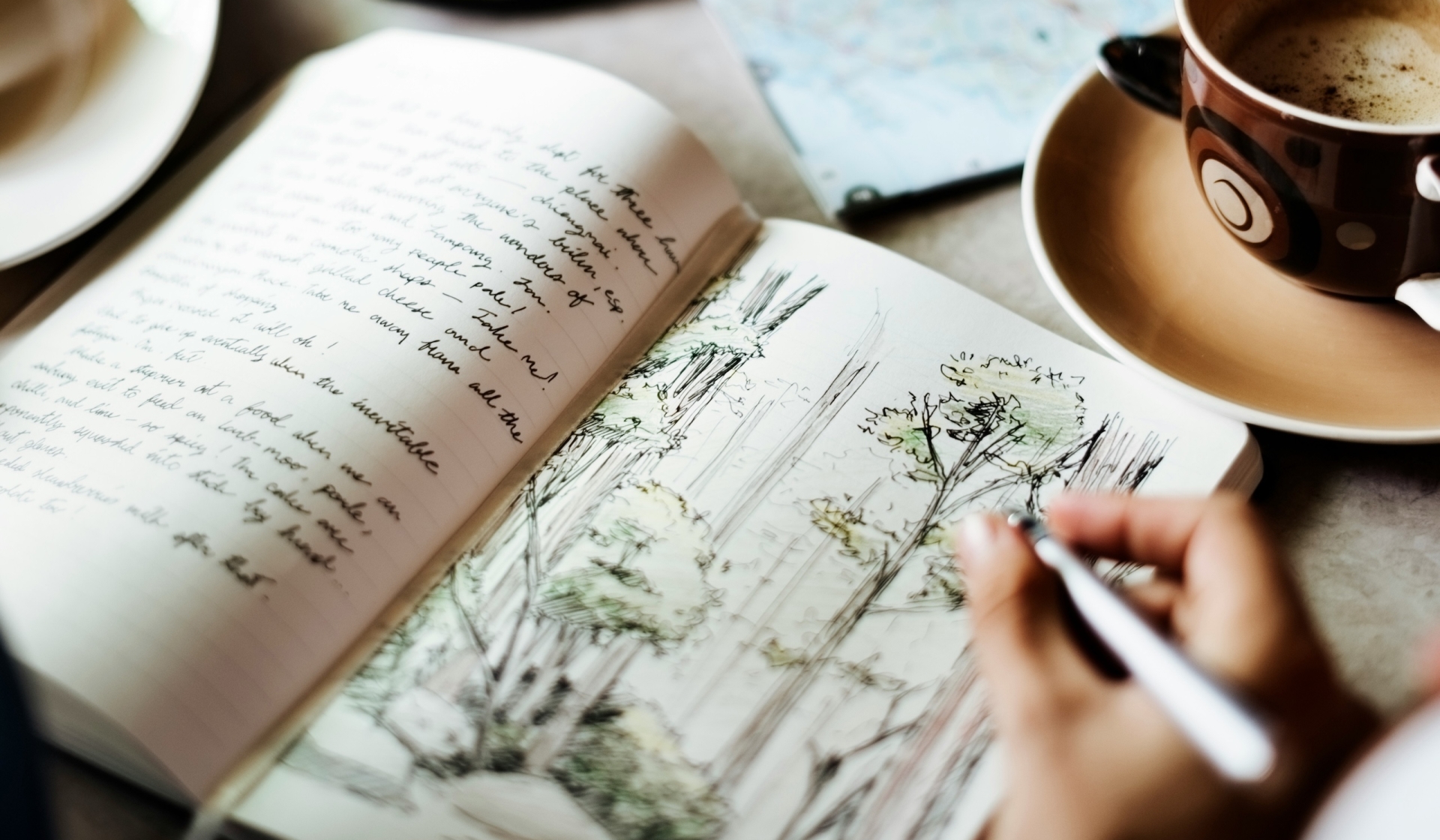
Note to Self
What science and history have to say about putting pen to paper.

The simple words “dear diary…” once began handwritten rants about school and best friends, revealed the names of love interests or simply shared what was on a writer’s mind at the end of a day. The diary was a confessional, a private vault, often hidden away or locked with a key to keep out wandering eyes.
These days, we have other confidants. Wellness apps ping us to log our moods. Voice memos and videos record our travel experiences. Yet the humble journal survives even amid these technological alternatives. Surveys suggest roughly half of us have kept one at some point in our lives, with about one in six actively journaling today.
“Though the words diary and journal are often used interchangeably, there is a subtle difference,” says Ana Juma, noted Journaling Educator. “A diary is more a chronological record of one’s thoughts, feelings, behavior or life experiences. The word itself comes from the Latin diarium, meaning daily — a fitting root for a form that has been around for millennia. The earliest known example, the Diary of Merer, was written on papyrus in Egypt some 4,500 years ago.”
Journals feel a bit looser — spaces to explore deeper, inner thoughts, emotions and personal growth. They might include a dream, an idea, a prayer or an unfinished poem. One is a record of a life, while the other is a record of the mind.
Whatever we call the final product, there’s a renewed interest in the practice of chronicling life. Many have found it to be a coping mechanism for the mind and body, a creative sandbox and, whether the writer intends it or not, a historical work in progress.
THE WRITE STATE OF MIND
“There is so much research out there showing a correlation between the act of expressive writing and improved cognitive function and emotional well-being,” says Lynda Monk, Director of the International Association for Journal Writing. “Going to the page enhances thinking, reasoning, mood and memory.”
The act of writing by hand forces the brain to process information more deeply, committing it to both the page and the mind at once. Scientists call this phenomenon the “generation effect,” referring to well-documented findings that information is remembered more easily when a person creates it themselves, rather than when it is read or heard. In the journaling space, a day recorded is a day twice lived — once in the moment and once in the retelling.
“Think about the slow, fluid motion of the pen moving across the paper,” says Monk. “The act of writing slows the mind and helps us to think more clearly and untangle problems. It can bring a sense of relief and calm, and suddenly, the days feel more manageable.”
Perhaps what makes journaling so appealing is its simplicity and accessibility. “Journaling is certainly not a cure-all,” she adds, “but it is such a simple, accessible tool. It doesn’t cost anything, really. All you need is a notebook, a pen and a few quiet minutes.”

For the record
Almost no one keeps a diary with an audience other than themselves in mind, but some of these logs have become historical documents, preserving a wealth of insights and details.
The journals Meriwether Lewis and William Clark carried up the Missouri River, beginning in 1804, brim with tales of indigenous tribes and grizzlies, cartographic notes and misspellings. They believed they were filing field reports for a president, not creating literature for the ages. Yet those dirt-stained, matter-of-fact entries remain the earliest accounts of America’s westward exploration and expansion.
Another example is the diary of Samuel Pepys, a rising naval administrator in 1660’s London who recorded nearly a decade of daily life in a coded shorthand, leaving the volumes to gather dust in his personal library. Yet historians have mined his pages for some of the richest firsthand accounts of Restoration England we possess, including his record of the coronation of Charles II in 1661 and the Great Fire of London in 1666. His countless entries pass down how Londoners shopped, dined, courted and entertained themselves.
Leonardo da Vinci filled over 13,000 pages with a backward mirror-script revealing his thoughts on art, nature and philosophy, as well as sketches of anatomy, weapons and fantastical flying machines. Marie Curie’s laboratory notebooks recorded her work with radium so faithfully that the material absorbed it. Years later, they rest in protective, lead-lined boxes in Paris.
Even presidents have kept journals that are now part of the historical record. Ronald Reagan’s journals reveal a close, unvarnished look at his presidency, from Cold War summits to quiet evenings in the White House residence. But the entries that charm readers most are the ones about his wife, Nancy. Reagan filled pages with his love for her, noting how much he missed her whenever they were apart and marking each wedding anniversary, pondering why she had married him. In one entry, he wrote that he was simply “not whole without her.”
AN ANALOG COMEBACK
It would be reasonable to deem the notebook a thing of the past. Obsolete. Finished. The smartphone, after all, can do it all — take notes, set reminders, track moods and save photographs and video recordings that replace memory itself. Yet the generations raised on screens are turning back to paper in droves. Bookstores are witnessing this writing resurgence, and in response, are offering large walls of journals — lined, blank, gridded, leather-bound.
Monk speculates that Millennials and Gen Zers, as well as the rest of us, long to escape the chronic mental and physical exhaustion caused by prolonged exposure to digital devices. People are, in a word, tired. “Journaling and writing serve as a digital detox,” says Monk. “It helps them slow down and think about life goals.”
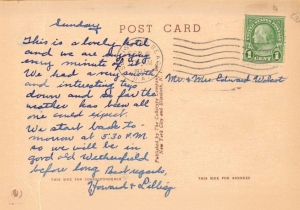 Monk mentions that young people are returning to the tactile and the slow — taking up knitting and needlework, weaving baskets, kneading bread and reaching for vinyl records and turntables over streaming music on devices. The journal fits this pattern well. It does not buzz, flash or scroll. One of the oldest forms of recording a life turns out to be one of the trendiest ways to unplug.
So this evening, someone, somewhere, is quietly writing about an ordinary day — the errands, an argument, a surprisingly good meal — and feeling lighter. Their passage will read like nothing much, as did Merer’s cargo logs and Reagan’s musings about Nancy, but the record of a life never knows what it will become.
WISH YOU WERE HERE
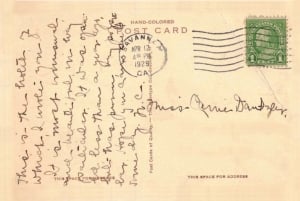 In the decades before curated travel blogs and social media feeds peppered with geotagged photos, historical travelers relied on analogue means of tracking their adventures. While non-digital methods have largely faded with time, the evergreen favorite of roadtrippers everywhere has managed to cling to cultural relevance. This undisputed champion of 20th century travel souvenirs? The postcard — a journal entry with a stamp.
“Like a diary, the postcard captured a moment in the writer’s own hand,” says Sea Island Archivist Mimi Rogers. Many such cards are kept for a lifetime, passing into family archives and hotel collections, as a loved one’s journal does. Rogers has spent hours poring over postcards in the Sea Island archives. “Some are quite old — sepia-toned,” she says. “I love to read what was written and see the different handwriting styles that our guests used almost 100 years ago.”
The impulse to write down what we notice is also alive and well at the Creativity Conference, held each year over the Martin Luther King, Jr. holiday weekend, where some 400 members and guests gather for TED-style talks. Speakers draw from their own lives. “Delia Owens, who spent 23 years in Africa studying wildlife, had everyone in the room on the edge of their seats,” says Sea Island Associate Director of Marketing, Dusty Brown, who organizes the event. “Amy Tan described her pandemic birdwatching journal — sketches and notes — that became the bestselling ‘The Backyard Bird Chronicles.’”
Fittingly, every table is set with notebooks, pads and pens. “The notes are coveted and sacred,” Brown says. “We’ve had members and guests preserve their conference notes for years and even bring them back for discussion.” The next conference is January 15–16, 2027. Bring a pen!