




Taking Flight
The evolution of aviation, from early airfields to modern private travel.
In June of 1914, a small seaplane lifted off from the waters of Tampa Bay carrying a single passenger who had paid five dollars for the privilege. The aircraft, piloted by aviation pioneer Tony Jannus, completed the 23-minute journey to St. Petersburg, Florida, marking what historians consider the first scheduled commercial airline flight in history.
In the early decades of aviation, aircraft ownership belonged almost exclusively to wealthy industrialists and hobbyists. Business leaders like Howard Hughes and Henry Ford were among the first Americans to recognize the strategic advantages of personal aircraft, using them to move quickly between factories, offices and projects across a rapidly expanding nation—but the true catalyst for the aviation we know today arrived after World War II.
The Postwar Takeoff
By 1945, the United States had trained hundreds of thousands of pilots and built over 5,600 airfields across the country. Wartime manufacturing had also dramatically improved aircraft reliability and range. When the war ended, a surplus of planes, trained aviators and newly available airports suddenly made flying accessible to civilians in ways it had never been before.
The period gave birth to what became known as “general aviation,” a category encompassing privately owned aircraft used for business travel and recreation. American companies quickly recognized that aviation was faster than rail or road, so by the 1960s, corporate aviation departments were appearing in industries ranging from manufacturing to oil and finance.
Aircraft manufacturers responded with purpose-built business aircraft. In 1963, Learjet introduced the Learjet 23, the first widely successful business jet. Fast, compact and capable of flying above commercial traffic, the aircraft reshaped expectations around general aviation and helped define the modern business jet market.
The Rise of Private Aviation
Through the latter half of the twentieth century, private aviation evolved from a symbol of wealth into a practical tool for mobility. Unlike commercial airlines, which connect travelers primarily through major hub airports, private aircraft can access thousands of smaller regional airports scattered across the United States.
History of McKinnon St. Simons Island Airport
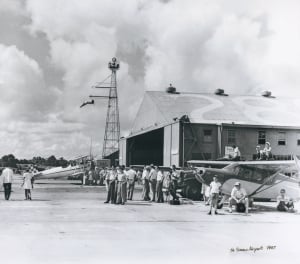
Few pieces of infrastructure on Georgia’s coast carry as much quiet historical weight as McKinnon St. Simons Island Airport. Its story is deeply intertwined with Sea Island itself and the broader evolution of American aviation.
The airport’s origins date back to the 1930s, remarkably early for a community of this size. Its creation was largely driven by Howard Coffin, founder of Sea Island Company and a pioneering automotive engineer who helped lead the Hudson Motor Company. Coffin’s fascination with engines and forward-looking technology naturally extended to aviation. During World War I, he served as an advisor to President Woodrow Wilson and championed the strategic importance of aircraft—a vision that would shape St. Simons Island.
“By the end of the First World War, he had strong ties to aviation leaders like Charles Lindbergh and was connected to the engineering and manufacturing efforts behind the Liberty engine that powered Allied aircraft,” said Mimi Rogers, longtime Archivist and Historian for the Coastal Georgia Historical Society “Coffin also recognized that aviation would eventually move beyond military operations and civil services such as mail delivery to become a viable form of passenger transportation. He saw the value of an airport located just minutes from Sea Island.”
Opening in the late 1930s, the airport’s role expanded dramatically during the Second World War. Civilian pilots initially patrolled for German U-boats, but the U.S. Navy soon took over the airport for pilot training and for an advanced radar training school. Nearby Brunswick hosted a naval airship base, and together these facilities formed a critical coastal defense network.
After the war, the airport returned to civilian control and began supporting scheduled airline service tied largely to tourism, evolving into a hub for private and recreational aviation. Now, nearly a century later, McKinnon St. Simons Island Airport remains a vital gateway to Sea Island. From wartime patrols to modern private jets, its history reflects the enduring tradition of aviation in the Golden Isles.
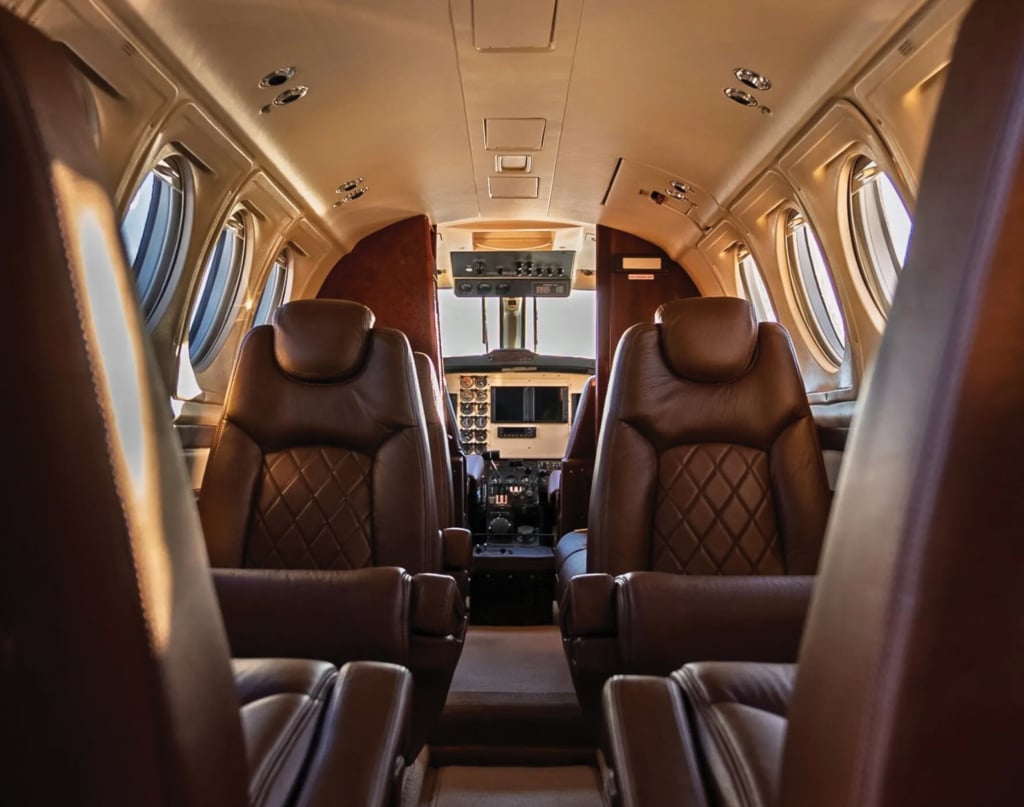
Beachcraft King Air private charter at Augusta Aviation.
This flexibility allows travelers to bypass congested terminals, land closer to their final destinations and often visit multiple cities in a single day. At the center of that ecosystem are fixed-base operators, better known simply as FBOs.
The term dates back to the early days of American aviation. In the 1920s, as air travel moved from barnstorming exhibitions to regulated flight, pilots and mechanics began establishing permanent aviation businesses at municipal airports. These operations—fueling aircraft, maintaining engines, training pilots and storing planes—distinguish them from the traveling aviation services that had previously defined the industry. For decades, FBOs functioned primarily as service garages for aircraft.

Sentient Jet charter parked at a private airfield.
As private aviation expanded through the latter half of the twentieth century, particularly with the rise of corporate jets and charter travel, these facilities gradually evolved into something more sophisticated. Today’s FBOs operate as private aviation terminals, offering a level of hospitality designed to streamline the travel experience for passengers arriving on private aircraft.
Instead of navigating crowded terminals or security lines, travelers typically step off the plane directly onto the ramp, where ground crews handle luggage, fueling and aircraft servicing while passengers move through quiet lounges designed for efficiency and privacy. Many facilities now include concierge services, meeting rooms, catering coordination and ground transportation waiting just steps from the aircraft.
“At Velocity, we talk a lot about performance with purpose,” says Chad Farischon, CEO of Velocity FBO at McKinnon St. Simons Island Airport. “Safety is always first, but beyond that, it’s about delivering a level of service that feels personal, not transactional. We want guests to feel looked after from the moment they arrive.”
The reach of private aviation is perhaps most evident in the places where these airports operate. Around the world, aircraft routinely land at airfields that would be impractical, or impossible, for commercial airline service.
In Colorado’s Rocky Mountains, private jets descend into Aspen–Pitkin County Airport, where a single runway carved into a narrow valley serves one of North America’s busiest winter aviation corridors. In the Caribbean, travelers bound for the island of Saint Barthélemy approach the famously short runway at Gustaf III Airport, dropping steeply over a hillside before touching down just steps from the beach. In the French Alps, specially trained pilots navigate the dramatically sloped runway at Courchevel Altiport, delivering skiers directly to one of Europe’s most exclusive resorts.
Even within major metropolitan areas, private aviation has developed its own specialized infrastructure. Just outside Manhattan, Teterboro Airport operates almost entirely as a private aviation hub, quietly moving executives, diplomats and travelers into New York City without the congestion of commercial airline terminals.
Together, these airports form a global network designed for flexibility rather than scale. The United States alone has more than 5,000 public-use airports, far exceeding the number served by commercial airlines.
Along Georgia’s coast, aircraft regularly descend into McKinnon St. Simons Island Airport, located just minutes from Sea Island.
“When you can land ten minutes from where you actually want to be, the entire travel experience changes,” says David Furnish, Vice President of Sales and Marketing at Sea Island and Vice Chairman of the Glynn County Airport Commission. “When you look at the growth of private flights into McKinnon over the past decade, it’s clear that aviation is playing a larger role in how people discover and experience the Golden Isles.”
Commercial travelers have convenient options as well. Brunswick Golden Isles Airport sits about 30 minutes away from the resort, while Jacksonville International Airport and Savannah/Hilton Head International Airport are each just over an hour away.

Private Aviation Today
While private aviation has been evolving for decades, the industry experienced its most dramatic surge in recent years.
In 2020, global travel was completely reshaped with many travelers seeking greater control over their environment and schedules. The number of commercial flights shrank, airports grew more unpredictable and travelers who had never considered private aviation began exploring alternatives.
At the same time, new models towards private aviation were also making it more accessible to people.
Fractional ownership programs allow multiple clients to purchase shares of a single aircraft and divide flight time among them, spreading both cost and operational management across several owners. Membership programs and jet cards offer another option, allowing travelers to purchase blocks of flight hours that can be used across a fleet of aircraft without the responsibilities of ownership.
That shift proved particularly important during the pandemic years, when travelers looking for flexibility could enter the market without committing to a full aircraft purchase. Aviation intelligence firm WingX reports that global business aviation activity now exceeds 3.7 million annual private jet flights, roughly 35% higher than pre-pandemic levels.
Many first-time private flyers discovered the advantages of charter, fractional ownership and membership programs, and a large portion have remained in the market even as commercial travel has recovered.
“Today, sophisticated fliers across all markets have more choices than ever to find the right solutions that fit their needs,” says Alan Walsh, President of Sentient Jet. “We’re seeing larger family groups undertake experiential travel to sporting events, concerts and special occasions, utilizing larger cabin aircraft to fly comfortably together while enjoying convenience and privacy.”
Technology is also reshaping the in-flight experience. “With onboard connectivity through more advanced satellite Wi-Fi offerings, private terminals and minimal waiting, our clients can remain fully productive while traveling and adapt plans in real time,” Walsh explains. “Across the private aviation landscape, reliable connectivity is becoming a standard.”
For many travelers, the shift reflects a broader change in how private aviation is perceived. “What’s changed in the value proposition is that clients now view private aviation as a productivity and lifestyle tool,” Walsh says. “The value is in the ability to depart when you want, fly closer to your destination and spend more of your time where you actually want to be.”