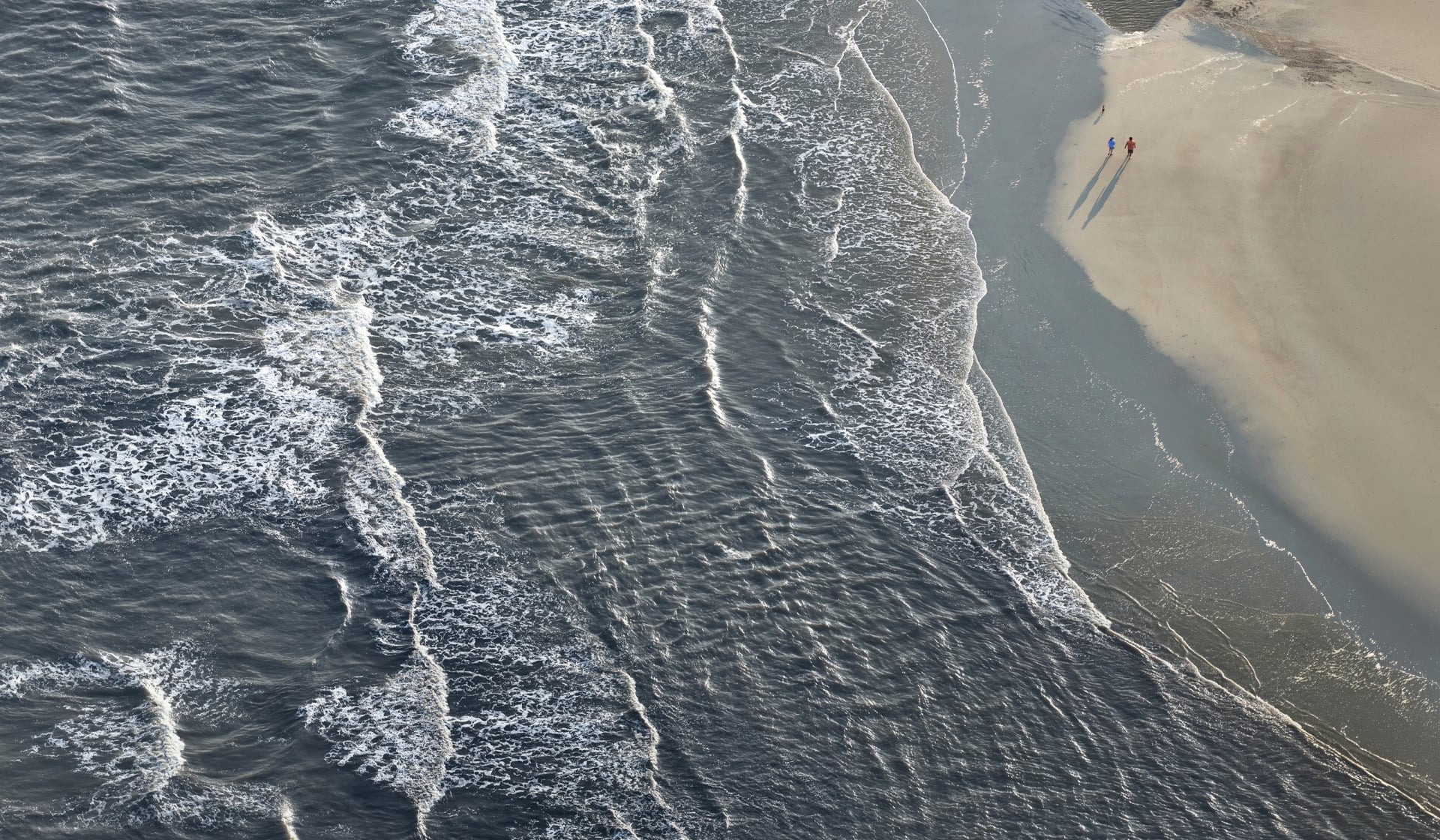
The Color of Water
How what lies beneath the water’s surface shapes its shifting hues.
More than two-thirds of the Earth is made up of water and while its compound makeup is quite simple—two parts hydrogen, one part oxygen—its color varies with the vantage from which it is seen.
In order to understand what makes up the color of water around the world, one must examine the way that color is reflected. All colors lie within a spectrum of black and white, and the color that is seen is reflected back by what is not absorbed by the human eye. Water that appears green is due to the fact that every color has been absorbed except that of the chlorophyll-rich phytoplankton that live beneath the surface. A vast stretch of open ocean far from the shore will appear blue because there’s almost nothing that absorbs light in the ocean except the water.
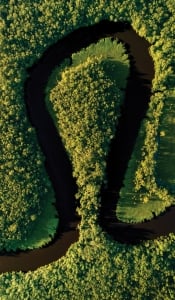
The Altamaha River
Courtesy of Benjamin Galland Photography
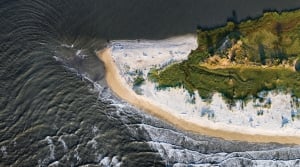
Black Banks River meets the Atlantic Ocean on Sea Island Beach. Courtesy of Benjamin Galland Photography
THE SCIENCE BEHIND THE SATURATION
While one body of water may appear in crystal blue hues, another may appear in rich earth tones. Scientists know that variations in water color around the world are a reflection of what is happening beneath the surface. “There is information in the color of the ocean that allows scientists to estimate what’s growing there,” says Bill Miller, Professor of Marine Science at the University of Georgia. “The color of water is so informative depending on the spectrum you see, that from there you can make a calculated guess of what’s going on in the ecosystem.”
Color is such a vital indicator of an ecosystem that the National Oceanic and Atmospheric Administration extensively monitors it through the use of remote satellites. The satellites contain a visible infrared imaging radiometer (VIIRS) that is able to detect spectral changes in the water. A dedicated team—the NOAA/STAR Ocean Color Team—uses this data to assess water quality, climate change and marine ecosystems.
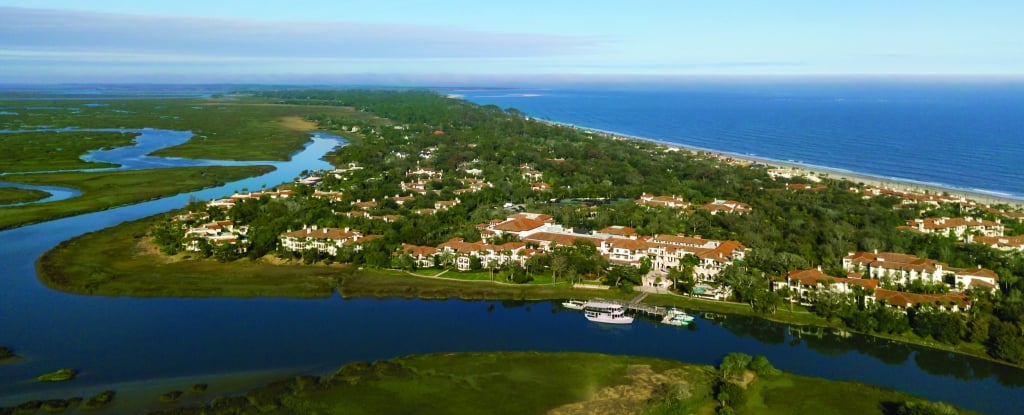
GOLDEN MARSHES OF SEA ISLAND
Georgia’s coast is home to 378,000 acres of salt marsh, vast wetlands where fresh and saltwater meet. The region near Sea Island is often referred to as the Golden Isles because of the Spartina marsh grass that grows in the surrounding wetlands, the color of which varies seasonally, turning golden in fall and winter, and green during the spring and summer months. According to Haley Watkins, Lead Naturalist at Sea Island, it is these marshes that make the ecosystem so unique. “The marshes that surround Sea Island serve as a buffer to the island during high tides while also creating habitat for oysters and other filter feeders that improve water quality. This benefits both wildlife and people alike,” Watkins says. The marshes also serve as a critical wildlife habitat. “They act as a huge nursery ground for what’s out in the ocean,” Watkins says. Marine life such as shrimp, fish and sharks come to the marshes to have their young in a protected environment. Watkins, a native of St. Simons Island, also credits the marshland for her appreciation of the outdoors. “When I look at the marshes, I see two things. As a naturalist, I see it as an abundance of wildlife. But as a local, I see it for what made me fall in love with the outdoors.”
On the Georgia coastline, the color of water is most impacted by the convergence of freshwater and saltwater, where river and ocean meet. This confluence begins with the Altamaha River, a major river in Georgia that flows eastward for 137 miles before draining into the Atlantic Ocean, by Sea Island.
Though the confluence of river and ocean water happens on coastlines throughout the world, no two are exactly alike, due to the currents and materials that exist in the environment. On the northernmost East Coast, a rocky coastline affects the color of the water, appearing more brown, while the blue-tinged color of water on the West Coast is affected by the abundance of kelp in the water. Similar to the Georgia coast, the Chesapeake Bay is an estuary where ocean and river water meet. The Chesapeake Bay’s brownish green water is what makes for a biologically abundant environment where crabs, oysters and fish can thrive.
On Sea Island, it is precisely this water quality that allows for such a complex ecosystem to prosper. Haley Watkins, Lead Naturalist at Sea Island, remarks,“ The color of the water around Sea Island is reflective of a nutrient-dense environment that is the basis for the unique plant and wildlife that thrives in the region. It is the reason we have the variety of wildlife that call Sea Island home.”
Professor Miller agrees that without this extraordinary combination, the region wouldn’t be home to such a verdant and diverse ecosystem. “Many people want to see the bottom of the ocean, as you would in the Caribbean. But that turquoise water means it actually has less life and is less productive as it relates to energy. The brackish water means that there’s more energy in the ecosystem and that is what makes the Georgia coast so full of life,” Miller adds.
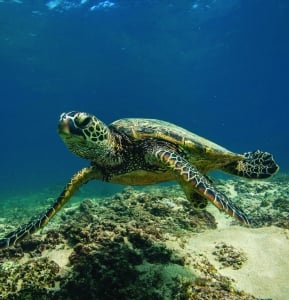
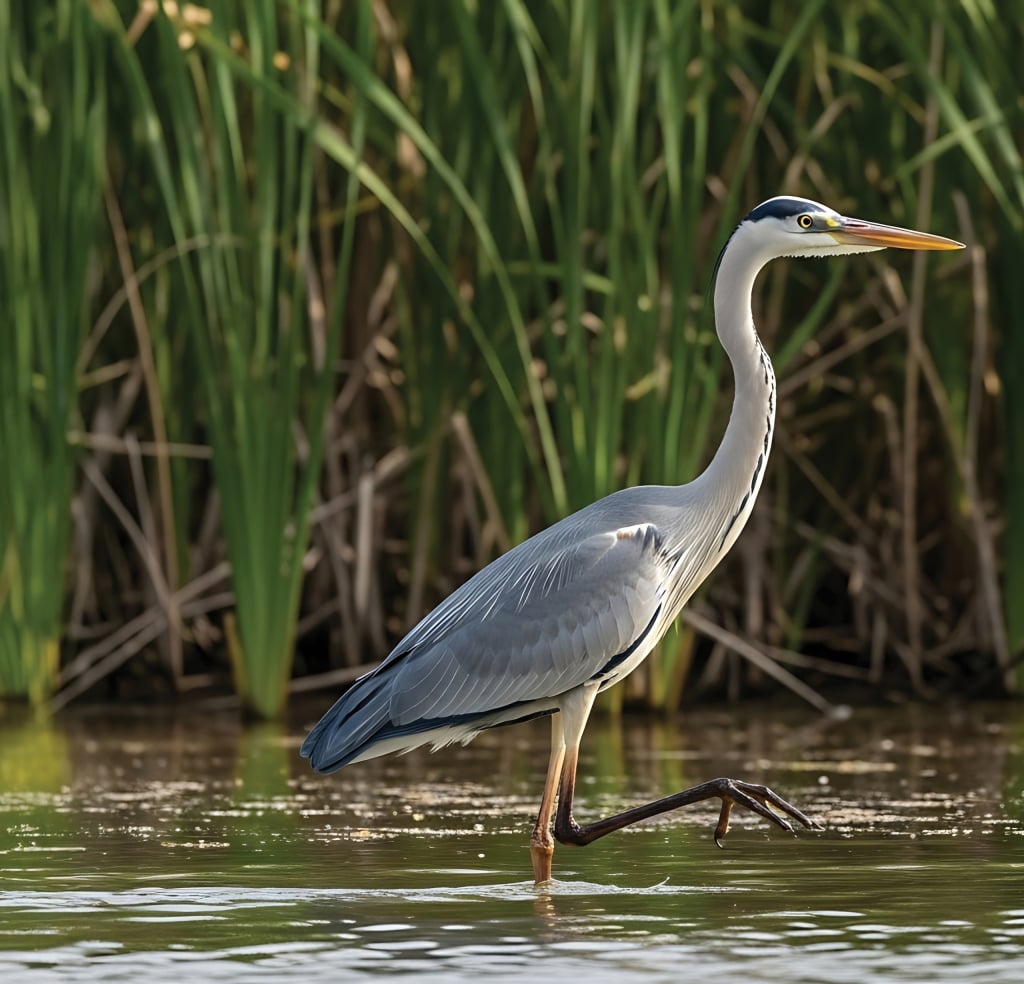
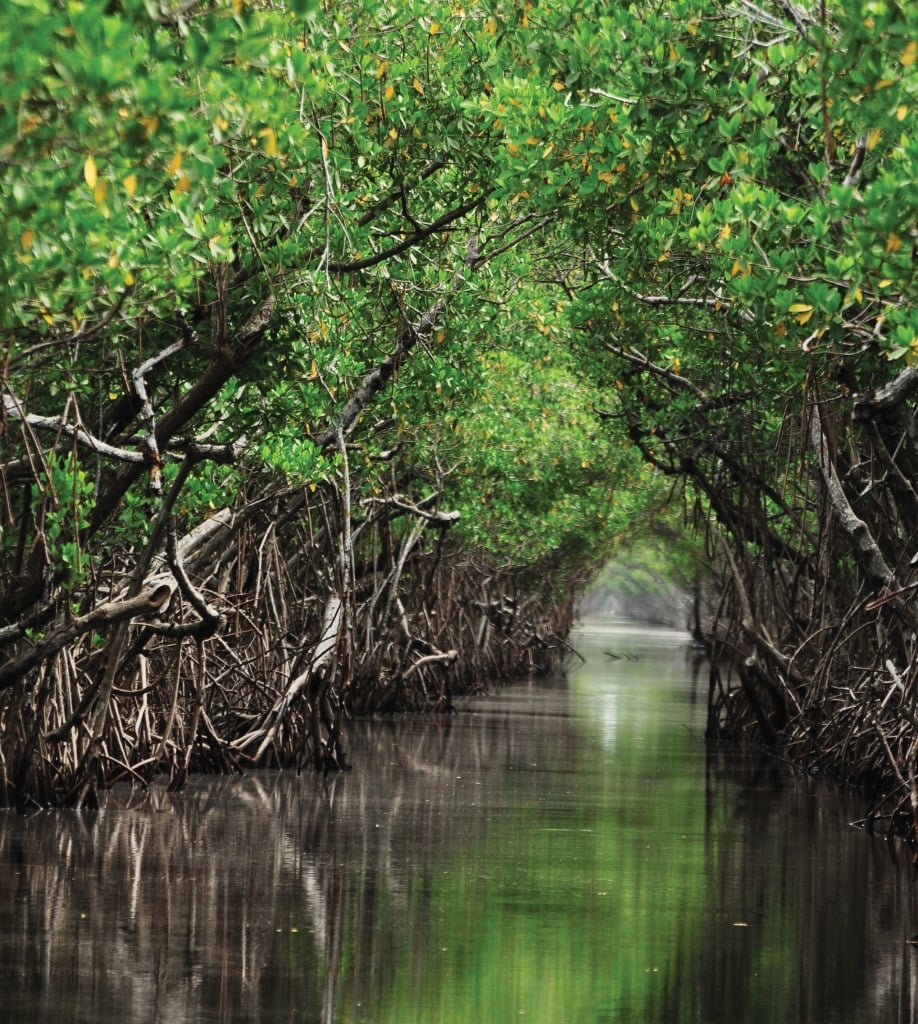
Loggerhead Sea Turtle (top left); Great Blue Heron (top right); Tarpon (bottom left); Mangrove Channel (bottom right).
THE COLOR CONNECTION WITH WILDLIFE
The color of water also determines what animals may call it home. Sea Island is home to dolphins, loggerhead sea turtles and invertebrates like crabs, oysters and clams. The water’s quality and color have a direct impact on the wildlife that live along Georgia’s coast. For many species, the water around Sea Island provides a nutrient-rich environment where they can safely feed, find shelter and reproduce.
The population of loggerhead sea turtles on Sea Island are able to flourish as a direct result of the water’s color. “Every year, thousands of hatchlings emerge along the shoreline and make the perilous journey towards the ocean,” says Watkins. “The color on the scales and flippers of loggerhead sea turtles directly mimics the water they are entering, providing camouflage and protection from predators.” In those first moments of life, blending into the water makes all the difference in their journey to the Sargasso Sea. The evolution between animal and habitat is interconnected, ensuring that wildlife thrives based on the quality and color of the water it inhabits. Over time, this relationship has shaped the variety of species that return to Georgia’s coast year after year.
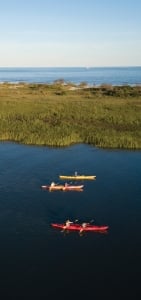
Kayaking by Rainbow Island.
The wildlife surrounding Sea Island is also greatly impacted by the tides. The Georgia Coast has one of the greatest tidal fluctuations on earth, with the tide changing every six hours as the water ebbs and flows through the marsh. These constant tidal shifts move water through an intricate network of creeks and estuaries, delivering nutrients and oxygen to the organisms that call those places home. According to Mike Kennedy, Director of Recreation at Sea Island, these tidal flows contribute to the abundance of shrimp, fiddler crabs and a myriad of other life, providing food for the fish that reside in these waters. “Our inshore fishery is robust, and the variety is amazing,” Kennedy says. “Menhaden is a filter-feeding fish, and our coast must have millions of them, along with speckled trout, redfish and the tarpon migrating in summer.” The varied marine life also provides food for a wide variety of shorebirds who stop at Sea Island to feed and gain weight before migrating as far as South America in the winter. For these migratory birds, the coastline becomes an essential refueling station along a journey that can span continents.
The full spectrum of water colors surrounding Sea Island reveals a story that can’t be told anywhere else. From earthy hues to shifting greens and blues, each shade reflects the delicate interplay of marsh, river and ocean that defines the region. “We have one of the most unique ecosystems on earth,” Kennedy says. “Every time I leave the island and come back, I’m amazed at how different Sea Island is. There is simply nothing that compares.”