


The Fire Kitchen
Rekindling the timeless practice of ancient open-flame cooking.
Long before there were ovens, recipes or chefs, there was fire. The earliest forms of cooking began with an open flame, and little regard to technique or flavor. Yet despite its humble origins, live-fire cooking continues to be humanity’s most unifying culinary foundation, shaping cuisines across the world.
Around 200,000 years ago during the Paleolithic era, cooking over an open flame became an intentional act, and the earliest hearths were simple fires surrounded by stones. As humans spread across continents, they developed more efficient ways to harness the power of flame, based on their geography, culture and resources.
As populations spread across the world, different cultures developed their own ways to cook over open flames. In Europe, meats were roasted over a spit, while North African cooking traditions used charcoal, since wood was a scarce commodity. In the Pacific Islands, volcanic stone pits became ovens, while Australian Aboriginal communities developed earth ovens that cooked game beneath heated stone.
In North America, indigenous peoples mastered innovative ways to cook long before the Europeans arrived. Cedar planks were a method to cook fish over fires, while smokehouses were used to preserve salmon through the winter. In the Caribbean, indigenous Taîno people built a framework to cook overcoals, keeping the meat away from the live flames. The Spanish called this technique “barbacoa,” a word that would later evolve to barbecue.
Heirloom Fire’s outdoor barbecue
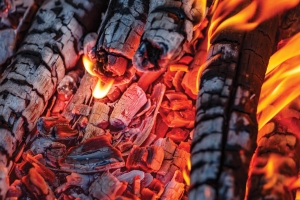
Firing up embers
MODERN LIVE-FIRE COOKING
While live-fire cooking has existed for millions of years, a growing number of modern chefs are returning to ancient live-fire techniques — embracing smoke, embers and open heat as both a culinary tool and a connection to tradition. “There’s a combination of factors that have
led more people to live-fire cooking,” says Food Historian and Archaeologist Paula Marcoux. “Live-fire brings much more flavor, texture and intensity to food, and people want something real that is done by hand.”
Live-fire cooking may be a trend as old as time, but it continues to find its way into the kitchens of the world’s top restaurants. While chefs everywhere may put their own stamp on live-fire cooking, few have elevated the technique to an art form quite like Argentine Chef Francis Mallmann. Also known as the “Godfather of Fire,” Mallmann trained early in his career in French haute cuisine, before returning to Argentina to focus on open-fire techniques inspired by gaucho culture. Between France and Patagonia, Mallmann defines the culinary direction of sixteen restaurants that consistently rank among the best in the world. His third and latest cookbook, Green Fire, defies traditional expectations of barbecue by highlighting the opportunities unlocked by applying flame to the bounty of a garden. “Almost all of the techniques we use for fires are good for fruits and vegetables,” says Mallmann. “I love how smoky they get. The planchas, the dome cooking, the wood oven, the pit — they’re so delicious, vegetables cooked in a pit.” His mastery off flame, smoke and embers has played an integral role in propelling flame cooking into the modern culinary spotlight.
Today, chefs around the globe are carrying ancient traditions forward, using flame as both a technique and a source of inspiration in global cuisine. In Japan, the robatayaki style relies on cooking fresh ingredients over a long open charcoal grill of glowing embers. The name “robatayaki” roughly translates to fireside cooking. In Spain, Basque cuisine utilizes open-flame techniques in its asadores, or “grill houses,” where ingredients are roasted over a large wood- fired grill. In the American South, barbecue is one of the best-known expressions of live-fire cooking, where chefs use wood, smoke, embers and time to extract flavors and aromas.
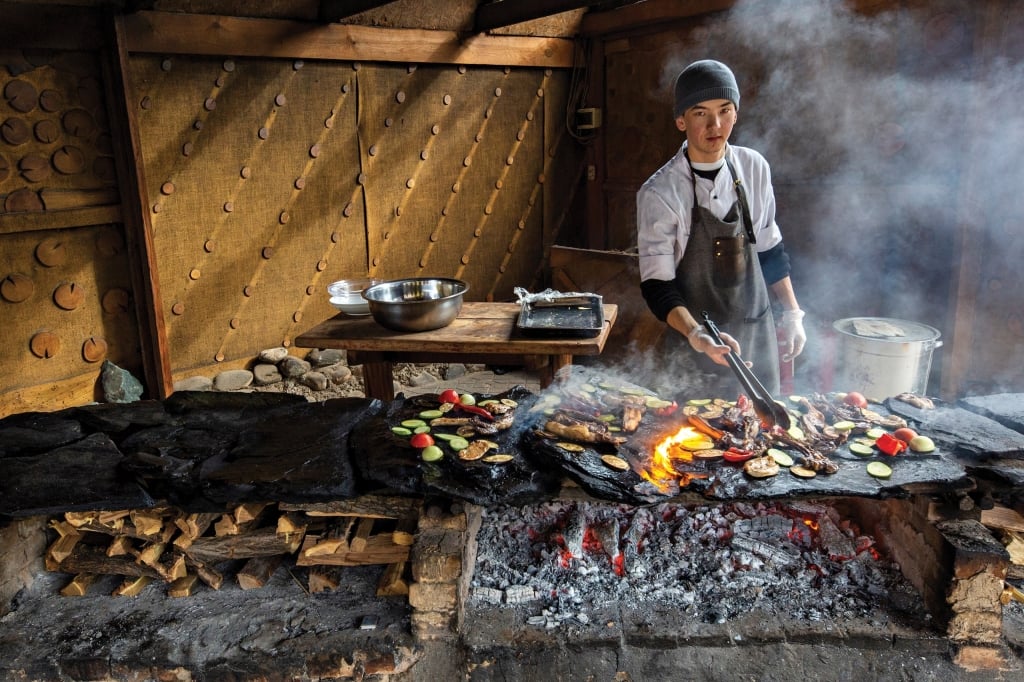
Traditional stone-slab grill in Bishkek, Kyrgyzstan
Wood coals
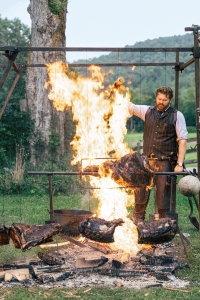
Chef James Gop of Heirloom Fire
Cooking with live – fire requires at tention to detail, from the woods election to maintaining consistent temperature over long periods of time. “Fire teaches you to read heat instead of selecting a temperature. You learn the difference between flame, radiant heat, smoke and amature bed of coals,” says Massachusetts Chef James Gop. His company, Heirloom Fire, hosts large – scale culinary events using only open – flame cooking techniques.
Mallmann builds on the idea of reading the fire, suggesting that getting to know it comes only through experience. “You have to go stand, watch a fire and understand it. There’s no way out. I can give you advice but I can’t give you a shock or an injection of fire knowledge.” It is a relationship built through observation — learning how flame behaves, when glowing coals are ready and how heat changes as a fire matures.
On Sea Island, live-fire cooking is used in nearly every restaurant, from the wood-fired ovens in Tavola to the cast iron kettles on Rainbow Island. “Live-fire cooking is all about intuition and patience,” says Chef Adam Thomas, Culinary Director of Sea Island. Whether it’s smoking meats at a low temperature for hours or searing at a high heat, Chef Thomas advises anyone who is experimenting with live-fire cooking to trust the process. “One of the reasons live-fire cooking has become so popular is that it allows for a real sense of connection to the cooking process.”
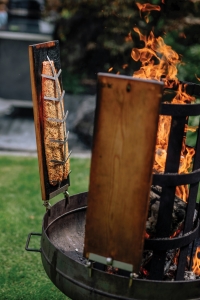
Salmon on cedar planks.
At Tavola, managing the flames of the wood-fired clay ovens requires patience and careful planning to maintain a consistent temperature. The wood plays a central role in getting it right. Sea Island sources post oak from a local family business, where the wood is seasoned for an extended period until it reaches an exceptionally dry state. Maintaining the oven’s consistent 600-degree temperature over several hours is the result of a measured and deliberate approach. “Even for something as simple as a wood-fired pizza, there’s an incredible amount of detail involved,” Chef Thomas says.
Born from humanity’s most primitive cooking methods, live-fire continues to shape the way people eat millions of years later. From the earliest kitchens of our ancestors to award- winning restaurants across the globe, this ancient technique has nourished for centuries, proving that the fire never truly went out.
TURNING UP THE HEAT AT SEA ISLAND
On Rainbow Island, live-fire cooking techniques are used for every supper. “Open-flame cooking is an integral part of the Rainbow Island experience,” says Chef Adam Thomas, Culinary Director of Sea Island. “Not only because it enhances the depth of flavor, but it connects members and guests to the experience.”
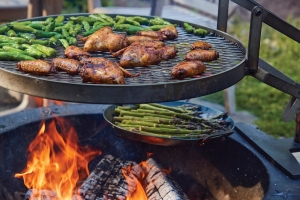
Roasting chicken and vegetables over a fire pit.
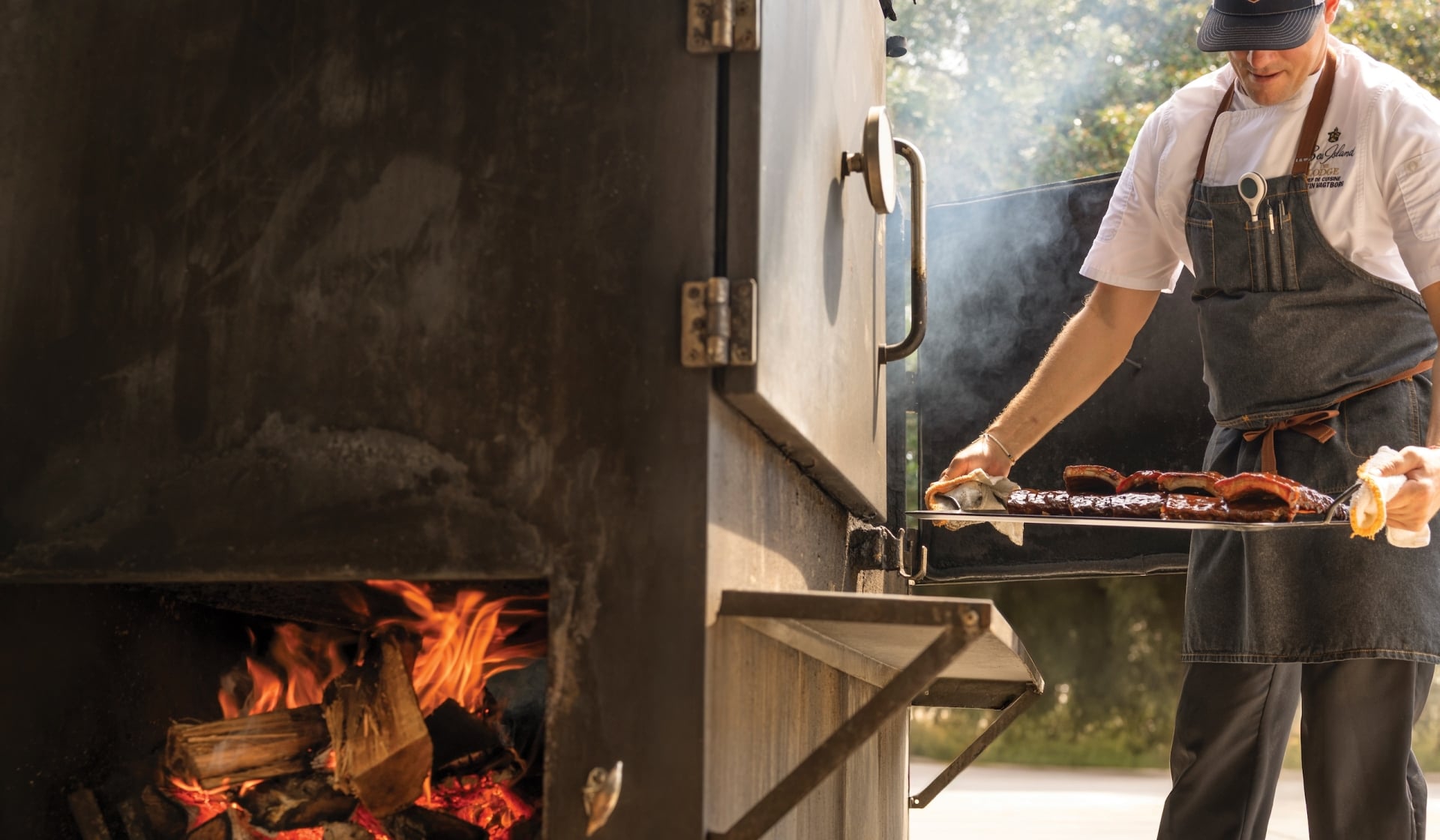
Sea Island Chefs cook over an open flame by using kettles, smoking grills and spits custom-made by Sea Island Forge, a family-owned company based on St. Simons Island. Fire-roasted oysters, bacon slabs, barbecued meats and even desserts are cooked over an open flame using various apparatus.
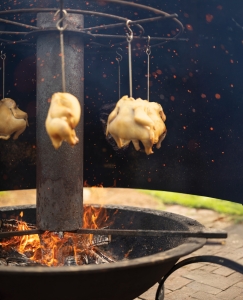
Rotisserie cooking is another method that relies on open flame cooking. At Sea Island, a custom-built rotisserie cylinder is used to make the signature sweet tea brined chicken, a consistent favorite at Rainbow Island Supper. Using a mixture of split oak and mesquite wood, the chicken is slow-roasted on a turning spit over open flame, resulting in a tender, juicy bird. “The sweet tea brine has a subtle bitterness to it that penetrates the meat, and the sugar in the tea gives it a nice char during the roasting process,” Chef Thomas says.
SWEET TEA BRINE
Prep Time: 5 mins
Cook Time: 30 mins
Yields: 1 gallon of brine
Ingredients:
0.5 gallon water, add more as needed
0.5 lbs. kosher salt
0.75 cup granulated sugar
2 tablespoons whole black peppercorns
4 cloves garlic, peeled and crushed
1 quart sweet tea
1 tablespoon liquid smoke, optional if oven roasting
1 quart ice cubes
Method: Place all ingredients except ice cubes and sweet tea in a pot. Bring to a simmer, stirring regularly so that the sugar does not stick to the bottom of the pot. Allow to simmer for 30 minutes, making sure the sugar and salt are completely dissolved. Remove from heat and strain into a large container. Add ice and stir until it melts and the mixture cools. Add the sweet tea and any additional cold water necessary to bring the mixture to 1 gallon. This is important to ensure the concentration of salt is correct.
RAINBOW ISLAND SWEET TEA BRINED ROTISSERIE CHICKEN
Prep Time: 12 hours
Cook Time: 1.5 hours
Yields: 4 to 6 servings
Ingredients:
1 while fryer chicken, giblets removed
1 large bowl or container, for chicken and brine
1 gallon sweet tea brine
Method: Rinse and dry the chicken. Place in a container and cover with the brine, ensuring it is fully submerged. Cover and refrigerate overnight. Remove the chicken from the brine, pat dry and refrigerate uncovered for at least 1 hour to dry completely. Preheat the smoker or oven to 375°F. Cook the chicken until the internal temperature reaches 165°F. If smoking, crisp the skin in a 450°F oven for 5–10 minutes. Let the chicken rest for 15 minutes before carving.