



Thinking Outside the Box
The enduring phone booth, a symbol of ideas that adapt and persist.
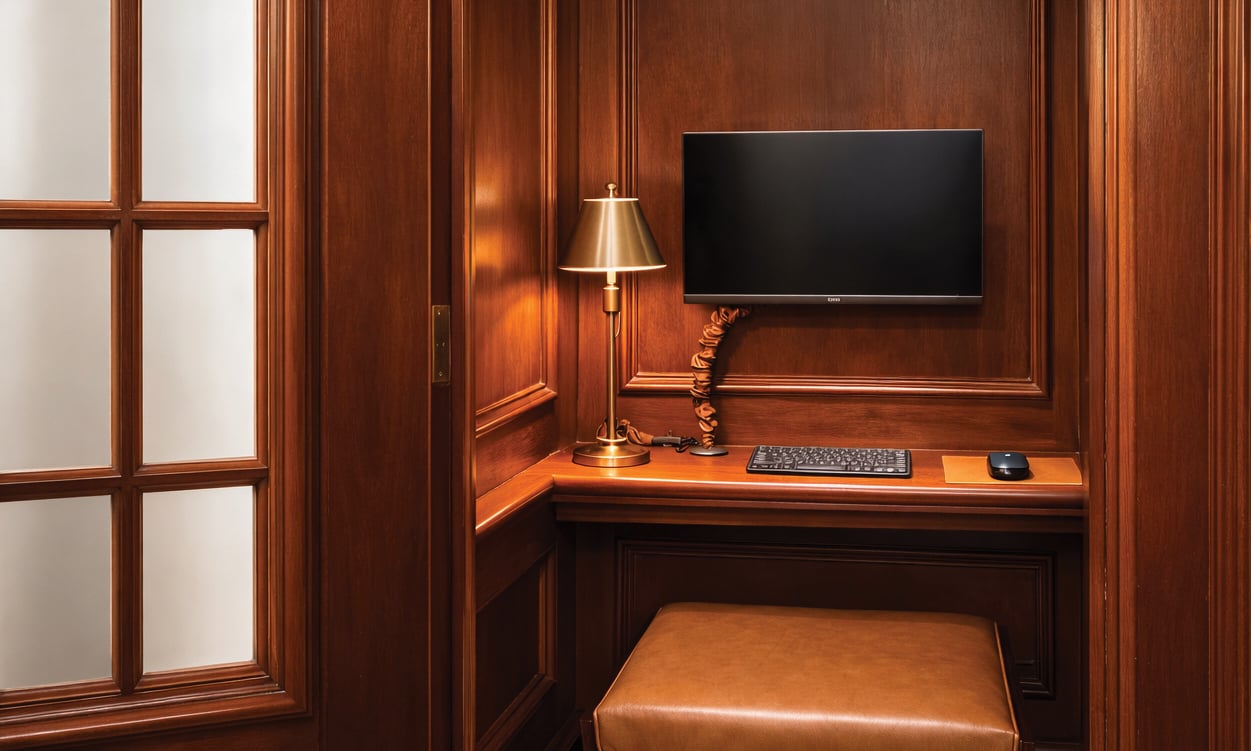
Above: The Business Booth at The Cloister.
In the golden age of comic books, Clark Kent often ducked into a phone booth to change from drab office clothes into bold Superman attire—red cape and blue body suit bearing the iconic “S” on the chest. In 1963, a frantic Tippi Hedren ran into a phone booth as hundreds of seagulls flew into the glass in Hitchcock’s thriller, “The Birds.” A few years later, Maxwell Smart stepped into a phone booth, deposited a coin in the slot, dialed a secret number and descended ten stories underground to headquarters in the hit television show “Get Smart.”

For decades, phone booths were everywhere—as much a part of culture as printed maps and typewriters. They waited on street corners and in hotel lobbies, inviting passersby to a refuge free from the noise and weather, where they could place a call in a more private setting. Some of these enclosures housed pay phones where a shiny, silver dime bought you a few minutes of talk time. Others, like those tucked near hotel reception areas, offered complimentary calls. Both types provided elements we’ve largely lost—phone books or city directories listing local residents, businesses and associated phone numbers, and more importantly, a door you could close for true peace and quiet.
The story of the phone booth dates back to 1881, when the world’s first “Fernsprechkiosk” opened at Potsdamer Platz in Berlin. Users purchased paper tickets called Telefonbillets for a few minutes of communication. But it was in America where the booth truly found its calling, so to speak.
A Hartford machinist, William Gray, developed the first coin-operated pay phone in 1889 after being denied access to a factory phone to call a doctor for his wife. His early prototypes operated on an honor system—users made a call, and the operator told them what amount to deposit afterward. Coins hitting a bell signaled to the operator that payment had been made. By 1911, the Model 50A brought together all the modern conveniences: pre-pay systems, coin return mechanisms and reliability. Within two years, 25,000 of them stood ready in New York City alone, lining subway platforms and filling the grand halls of Penn Station and Grand Central Station—while across the pond, Britain’s iconic currant-red phone booths were rising as cultural landmarks, offering a charming refuge for calls and a favorite backdrop for films and photos.
The booths that housed these phones also evolved. The early indoor models were crafted from wood—elegant cabinets with doors, lighting and sometimes even seats.
At The Cloister at Sea Island, one such booth has stood for decades, a silent witness to thousands of phone calls and nearly a century of American life. “Our booth recalls the bygone days when the presence of telephones was quite limited, and a lobby phone was a thoughtful and practical guest amenity,” says Mimi Rogers, longtime Archivist and Historian for the Coastal Georgia Historical Society.
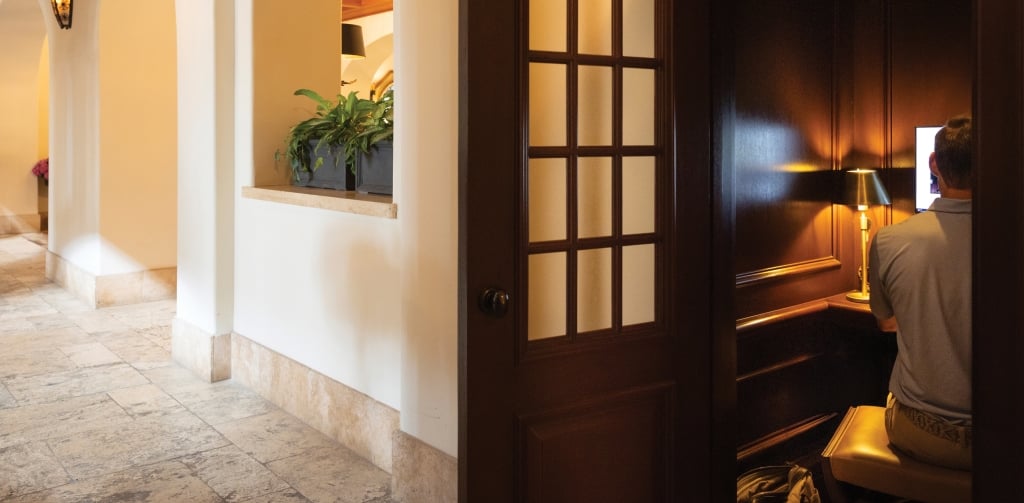
The Business Booth at The Cloister.
In 1999, roughly two million pay phones operated across America. Two decades later, only five percent remained. Cellular phones eliminated the need for public telephones, and, just like that, the phones—and their booths—became nostalgic reminders of yesteryear.
But The Cloister breathed new life into their enclosure. Rather than removing the historic phone booth, the resort reimagined it for modern travelers. Today, it is a compact, private business center. “We call it the Business Booth,” explains Matthew Denor, Director of Front Office at Sea Island. “There is a full computer set up in the space, with a comfortable stool and a work surface.”
The enclosure retains its original intimacy—rich, dark wood paneling, warm lighting from a small lamp, flooring that continues into the booth from the lobby, and most charmingly, an Ethernet cable fashioned from the original phone cord.
The Business Booth serves the same essential purpose it always has: providing privacy in a public space. “Members and guests use it all the time,” says Denor. “Guests often step into the booth to take a business call, ensuring their spouse and young children can continue their nap undisturbed in the room.”
This hidden gem reminds us that some relics can evolve alongside us and serve new needs. Where Superman once found a place to transform into something greater, so too has the phone booth, though today’s guests still find what they’ve always needed: a convenient refuge, a door that closes and the timeless craftsmanship of a space built to last. The phone booth in The Cloister hasn’t disappeared—it simply remembered what it was always meant to be.