



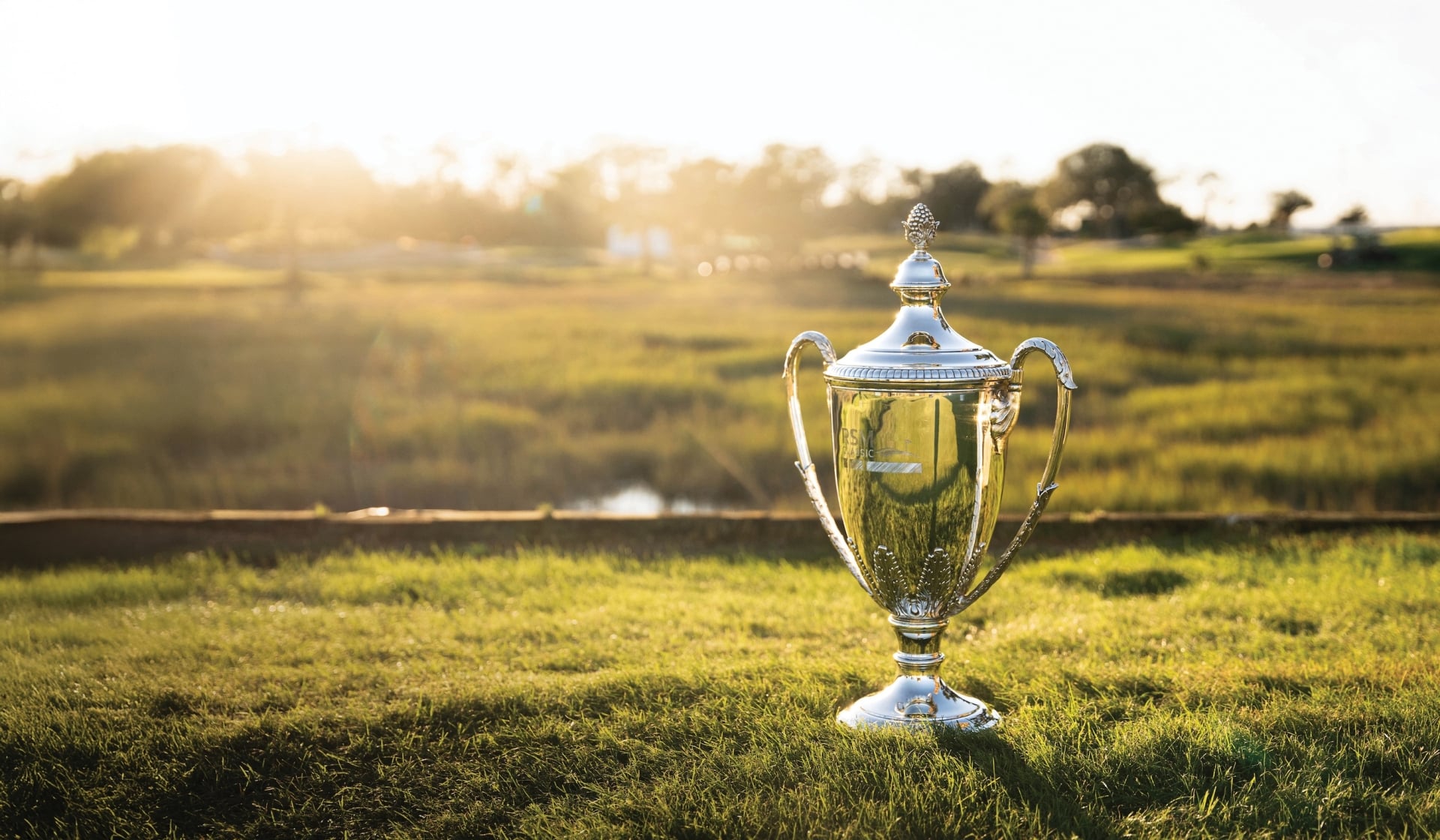
Winner Takes All
The trials and triumphs behind history's iconic trophies.
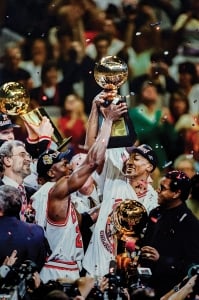
Michael Jordan and Scottie Pippen lift the Larry O’Brien trophy, 1991.
Few memories in modern-day sports history are seared into American fans’ minds as clearly as basketball great Michael Jordan bear-hugging the Larry O’Brien trophy after leading his Chicago Bulls to the 1991 NBA Championship. With his father, James, by his side, Jordan wept. As he wrapped his arms around the trophy, the Hall of Famer closed his eyes and leaned his forehead against the silver and gold vermeil treasure, a physical representation of the tireless work and years of dedication he and the team had put into achieving this mark of distinction.
The emotion captured in that moment is part of what makes championship trophies so powerful. They represent not only the achievement itself but the countless hours, failures and sacrifices required to reach that single defining moment. As Michael Jordan famously reflected, “I’ve failed over and over and over again in my life. And that is why I succeed.” The trophy may commemorate the victory, but the journey behind it is what gives it meaning.
Like most trophies in sports history, the NBA Finals Championship award — topped with a replica basketball and manufactured by Tiffany & Co. — symbolizes more than just a victory. It is an emblem of triumph, accomplishment and honor. In many ways, trophies are a mirror to the values and ideals of the societies that hold them dear. Long after the final buzzer sounds or the winning putt drops, the trophy becomes the tangible reminder of an achievement that can never be repeated in quite the same way.
IN THE HISTORY BOOKS
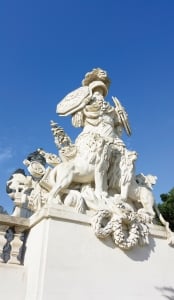
Tropaion sculpture in Vienna, Austria.
For centuries, societies have sought ways to commemorate triumph. Whether fashioned from olive branches, silver, crystal, bronze or even cloth, the objects awarded to champions have reflected not only athletic achievement but also the values and traditions of the cultures that created them.
The word “trophy” traces back to victory itself. From the Greek word “tropaion” — a monument ancient Greek warriors built on the battlefield using captured enemy weapons and armor to mark their triumphs — its meaning elicits literal spoils of war. Centuries before that tradition, victors at the Ancient Olympic Games were crowned with “kotinos,” or wreaths woven from branches of the sacred wild olive tree growing near the Temple of Zeus, a tree said to have been planted by the demigod Hercules himself.
Those olive wreaths carried no monetary value, yet they represented the highest honor an athlete could receive. Olympic champions often returned home as heroes. Their victories elevated not only themselves but also the communities they represented — a tradition that continues in many ways today.
Since then, victorious accolades have transformed in shape, meaning and importance. Beginning in the 5th century B.C.E., victors of the Panathenaic Games — civic and religious competitions held in Athens rather than the Olympic Games hosted in Olympia — received decorated ceramic storage jars called Panathenaic amphorae. These two-handled vases with narrow necks were often filled with coveted Athenian olive oil, and their design is said to have inspired the silhouette of the modern trophy.
In the 17th century, chalices and ornate cups of metal were awarded to winners for sports such as horse racing and boating. As sporting competitions shifted toward more organized events with official bodies overseeing them in the 19th and 20th centuries, trophy designs became more elaborate.

Jannik Sinner with the Gentlemen’s Singles Trophy, 2026.
IN PERPETUITY
Among tennis’s most recognizable awards is Wimbledon’s Gentlemen’s Singles Trophy, introduced in 1887. Standing 18 inches tall and crafted from silver gilt, the trophy features two ornate handles, intricate floral engravings and perhaps its most curious detail — a pineapple atop the lid. During the Victorian era, pineapples were rare imports and symbols of wealth and prestige, making them a fitting crown for one of sport’s greatest prizes. Its companion piece, theLadies’ Singles Trophy — officially the Venus Rosewater Dish — has been awarded since 1886 and is one of women’s sport’s most elegant and historic championship awards.
The Wimbledon prize is categorized as a “perpetual trophy,” a tangible accolade not kept permanently by the winners but instead passed on year after year. Winners are traditionally given scaled-down versions of perpetual trophies, like the Sea Island Women’s Amateur prize. Champions of this contest and others are commemorated in the Sea Island Trophy Room at The Lodge, a museum of memorabilia and trophies displayed for all to celebrate.
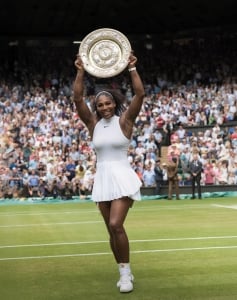
Serena Williams with the Venus Rosewater Dish, 2016.
Perhaps the most famous perpetual trophy is the Stanley Cup, hockey’s most famed trophy. Standing nearly 3 feet tall and weighing 37 pounds, the Stanley Cup is named after Lord Stanley of Preston, a former Governor General of Canada who was an avid sports fan and donated the original cup. The Stanley Cup is made of a gleaming silver and nickel alloy and consists of three main sections: a handcrafted replica of the original 1892 bowl, a tiered collar and five large, cylindrical bands at the base. It is the only major professional sports trophy that records the names of the winning teams and their team members. Every 13 years — the time it takes for a band to fill with champions’ names — a new band is added to the bottom, and the oldest band at the top is removed and retired to the vault at the Hockey Hall of Fame in Toronto.
Also unique to the Stanley Cup is the famous tradition that allows every player, coach and key staff member on the championship team to spend 24 hours with the Cup during the off-season. Stories from these day-long outings have been etched in sports lore. Thus, it has traveled around the world, receiving more mileage than the most hardened frequent flier. It has gone on holiday with David Krejci to his home country of the Czech Republic, to Sweden with Niklas Hjalmarsson and to Gorky Park in Belarus with Nikolai Khabibulin. French-born goaltender Cristobal Huet even took the Cup to the Eiffel Tower in 2010.
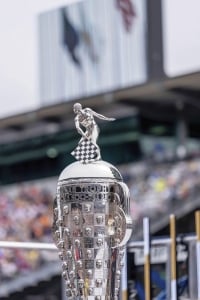
Borg-Warner Trophy
Yet in some sports, the most coveted prize isn’t a trophy at all. Since 1949, golf’s Masters champions have received Augusta National’s iconic Green Jacket, a symbol of membership in one of sport’s most exclusive clubs. Winners take it home for a year before returning it to their locker in Augusta National’s Champions’ Locker Room. Each champion also selects the menu for the following year’s Champions Dinner, creating a culinary record of golf history.
Golf has its own ways of ensuring champions are remembered. The PING Gold Putter Vault in Phoenix holds more than 3,000 gold-plated replicas of putters used in tournament victories, preserving decades of golf history one victory at a time. Among those commemorated are Sea Island Touring Pro Davis Love III, whose PING putter helped him win The Players Championship in 1992, and Tiger Woods, whose Anser 2 was preserved after his 1994 U.S. Amateur victory.
Symbolism takes many forms in horse racing, too. Kentucky Derby winners receive the famous Garland of Roses, draping the winning horse in a blanket of red roses for its victory lap. For the rare horse that wins all three of the sport’s most prestigious races — the Triple Crown — the achievement places it among an elite group of just 13 winners in history. Together, these illustrate how the symbols of success in sport extend far beyond a trophy cup.

Fernando Mendoza with the Heisman Trophy
Each championship has its unique design. For instance, the Heisman Trophy symbolizes a football player delivering his signature stiff-arm, celebrating individual excellence in America’s most popular collegiate sport. The Borg-Warner Trophy, presented to the Indianapolis 500 winner, features sterling silver sculptures of every champion’s face, transforming the award into a living timeline of racing history as each new victor is immortalized.
TRADITIONS WORTH KEEPING
The rich history of sporting culture at Sea Island rewards perseverance, determination and achievement, including The RSM Classic, an official PGA TOUR FedExCup event hosted by the Davis Love Foundation. Brannen Veal, Sea Island Director of Golf, says the winners aren’t just thrilled when they hoist a golfing trophy; they are relieved. “The key thing is that you earn it,” Veal says. “The athletes have not only been earning it that day, or the day before, but they have been earning it for years and really working at that craft. It’s a culmination of all that emotion coming in at once. You’ll see tears from all the years of work coming together for the win.”
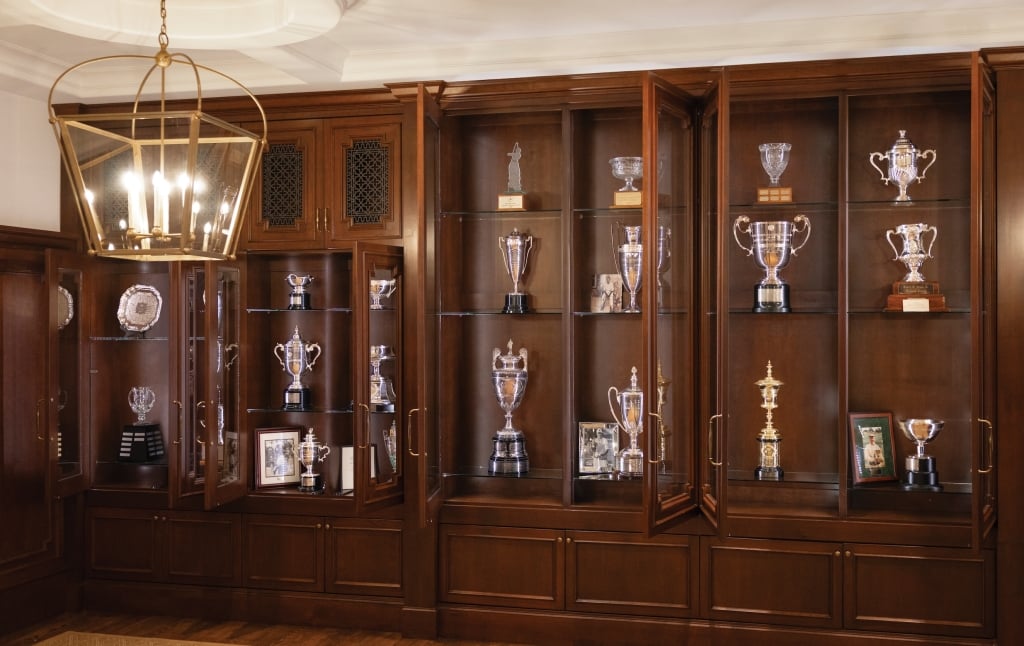 THE TROPHY ROOM
Nestled in the back of the main lobby of The Lodge, a quiet wall of stories overlooks the Speedway putting green and the St. Simons Sound. Golfers breeze through on their way to Plantation’s tenth tee, participating in the same tradition immortalized within the Trophy Room.
The rich golf history of Sea Island is a point of pride. The humble nine-hole beginnings in 1926 paved the way for three of the finest courses in modern golf. Over the decades, Sea Island members have delighted in celebrating both the progress of the courses’ development and their own progress playing them. The trophies displayed in the Trophy Room are living proof of victories by members, guests and touring professionals over the last 100 years.
The annual events hosted by Sea Island — including The RSM Classic, the Sea Island Cup and the Sea Island Women’s Amateur, to mention a few — shine front and center, and are flanked by Club Championship trophies to the left and USGA and international amateur victories to the right.
The array of trophies stretches back to the earliest years at Sea Island, starting with the 1929 Country Club Team trophy. Discerning eyes will find a trophy representing every decade of the 20th and 21st centuries from 1929 onward. An impressive collection of trophies won by Louise Suggs, one of the founders of the LPGA and, in turn, of modern women’s golf, also fills the display, ranging from her 1947 victory in the U.S. Women’s Amateur to her LPGA Championship win ten years later.
That sense of accomplishment extends beyond the golf course. One of the fastest-growing competitions at Sea Island takes place on the water, where the Tarpon Classic celebrates the area’s abundant summertime fishery. The trophy is as distinctive as the competition, featuring an intricately detailed silver tarpon poised above a polished cup and tiered black base bearing the names of past champions. Created just four years ago, the event has become more than a competition, according to Sea Island Director of Operations Mike Kennedy. It is a community celebration built around a resource that has long been part of the island’s identity.
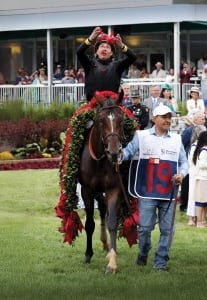
José Ortiz and Golden Tempo draped in the Garland of Roses.

Brian Harman with the Claret Jug.
“The fishing here has been a hidden secret,” Kennedy says. “Locals who love our ecosystem want to let the world know how good it is here in the summer.” The tournament adds another kind of championship tradition to Sea Island — one measured not just by a trophy, but by a shared appreciation for the place itself.
Every four years, a national soccer team hoists the FIFA World Cup trophy, an 18-karat solid gold sculpture depicting two human figures holding up the Earth. Designed by Italian Sculptor Silvio Gazzaniga, the idea of the trophy “was to create something symbolizing exertion, dynamism and the jubilation of an athlete in the moment of victory, with all the joy that contains,” Gazzaniga said.
The Claret Jug is one of golf’s most recognizable prizes, an award presented to the winner of The Open – one of the sport’s four men’s major championships. Two Sea Island Touring Pros have even won the prestigious trophy: Zach Johnson in 2015 and Brian Harman in 2023. The sterling silver trophy resembles a slim wine or claret pitcher with its slender body, curved spout and single handle. Like most trophies that have a conical-like shape, the Claret Jug has famously been used to consume celebratory drinks, such as when Tiger Woods drank Dom Pérignon Champagne from the vessel after his victory in 2000.
Whether it is the Stanley Cup making its annual pilgrimage around the globe, the Green Jacket returned to Augusta each spring, the Rosewater Dish presented on Centre Court or the trophy lifted on the 18th green at The RSM Classic, every championship trophy carries two tales. One belongs to the sport itself, etched through generations of tradition. The other belongs to the athlete whose years of sacrifice become forever linked to a single unforgettable moment.
Long after the cheers fade, it is those stories — not the silver or the gold — that give every trophy its true value.